


 Call to Buy 022 6537 6767
 Our Insurance Plans
 Term Insurance
 Insurance Made EasyPolicy Term PlansAffordable Term PlansTerm Insurance for All AgesInsurance for AllInsurance for Specific Needs
 Investment Plans
 Tools & Calculators
- Tools & Calculators
 Customer Services
 Policy ServicesPolicy & Account Services
 Quick Links
 NRI Corner
 NRI Plans - UAE
 NRI Plans - Saudi Arabia
 NRI Plans - Kuwait
 NRI Plans - Oman
 NRI Plans - United Kingdom
 NRI Plans - United States
 NRI Plans - Singapore
 NRI Plans - Australia
 NRI Plans - Canada
 NRI Plans - Qatar
 Claims
 Become a Advisor






ULIP Plan
A Unit-linked Insurance Plan or ULIP offers the dual advantage of being an insurance as well as an i... Read More
ULIP Plan
A Unit-linked Insurance Plan or ULIP offers the dual advantage of being an insurance as well as an investment product via market-linked funds. So the premiums you pay not only cover you but also get invested in funds of your choosing.
What Is ULIP (Unit-Linked Insurance Plan)?
How does a ULIP scheme work?

Premium Contribution
You need to pay the premium towards the ULIP insurance plan which you have decided to buy

Life Cover Protection
A certain portion of your ULIP insurance premium is routed towards securing your family’s future and building a financial safety net for your loved ones by way of a built-in life insurance policy. The payout benefit from this is paid to the nominees of the deceased policyholder in case something unfortunate happens to you during the policy term

Wealth Creation Investment
The other part i.e. remaining portion of this premium is then invested in the funds of your choice (equity, debt or even a mix of both)
Which means, not only is your family financially covered in case of any untoward happening (like the life assured’s death), but also your money continues to grow silently in the background and comes to your rescue during the different stages of your life for several important milestones.
Suppose you pay a premium of Rs. 1,00,000 annually towards your ULIP investment plan for a policy term of 15 years. Out of which, let’s assume Rs. 20,000 may be utilized towards your life cover.
Rs. 80,000 can then be invested in equity and / or debt funds of your choice. Considering an average of 8% growth per year, your Rs. 80,000 investment money can actually grow and become approximately Rs. 22 lakh* over the policy duration of 15 years.
*These figures are for illustration purposes only. Actual returns may vary depending on market performance and fund selection.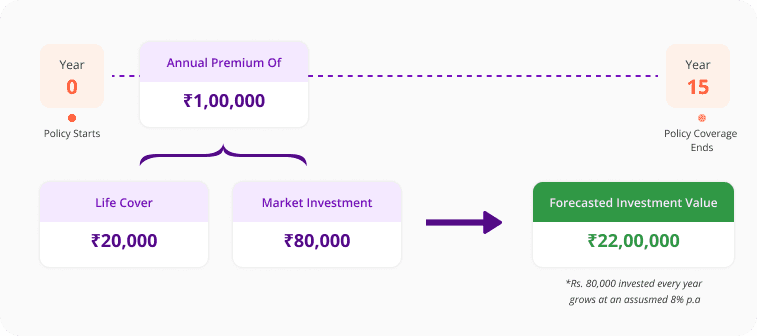
Explore OUR plans
tailored for all
Your future needs.

What do you think makes a ULIP scheme so important and special that you must definitely consider adding it to your financial plan this year?
ULIP plan: Key aspects

Beyond just an insurance product
Multipurpose plan (a unique tool that acts as a security / financial shield against life’s uncertainties, while also helping your money grow steadily, in turn creating lifelong value for your dependents)
More control over your current financial journey, because of the inbuilt dual advantages
Flexibility to invest based on your risk appetite
Money mindfulness for your family’s bigger milestones (like your child’s higher education / marriage, your spouse’s retirement plan, your dream home buying goal etc.)
Disciplined savings habit for structured wealth-building purpose
How Does A ULIP Insurance Plan Work?
Wondering how a ULIP (Unit-Linked Insurance Plan) makes your money work hard for you?
Let’s understand with an example :

Annual Premium for your ULIP Insurance:
Rs. 1,20,000
Monthly premium:
Rs. 10,000
Policy Duration:
15 years
Life Cover (as per plan design):
Rs. 12,00,000Investment Allocation :
per year towards your life insurance policy
remaining towards your chosen market-linked plan
ULIP funds are quite different from your traditional insurance plans. Depending on your risk tolerance, financial needs and fund preferences, you can choose to invest your premium in either equity i.e. shares (for higher potential growth, coupled with higher risk), or debt i.e bonds / securities (for stability, and lesser risk). You can even switch between the two fund options for a balanced combination during the policy term (this is suitable for moderate risk takers).
Moreover, ULIP plans offer tax benefits too - by way of deductions under Sec 80C for the ULIP insurance premiums paid. You don’t have to pay any tax on ULIP maturity as well [covered under Sec 10(10D)], subject to prevailing tax laws.
What are the possible outcomes in such a scenario?
*These are indicative values based on assumed returns. ULIP fund performance depends on market conditions, chosen fund mix, and applicable charges.
Key features of a ULIP plan
So, what does your ULIP scheme actually cover? Here are the top 5 noteworthy features in your ULIP insurance plan!
It all begins with the right allocation of your premium to the different purposes that are mapped to your ULIP scheme. The ULIP (Unit-Linked Insurance Plan) premium gets divided into 2 parts fundamentally. Before its allocation, a part of your premium is firstly utilized for ULIP insurance charges like policy administration, fund management etc. Then, a portion of this premium goes towards your life cover contribution.
So, while you build a financial corpus for your family’s future by investing in the right funds, your loved ones can still stay protected throughout. In case something miserable happens to you during the policy term, they shall receive the lump sum payout. Finally, the other part of the premium (balance) is marked as the investment portion, which is routed into funds of your preference.
Benefits of Choosing ULIP Scheme
A step-by-step guide on how the Ageas Federal term life insurance works.
- Higher returns with market-linked growth
- Long-term savings habit
- Option to choose between equity, debt or a balance of both
- Flexibility to switch between different funds during policy term
- Compounding advantage over time
- Tax deduction for premiums under Sec 80C
- Maturity benefits tax-free under Sec 10(10D)
- Disciplined lock-in period built-in
- Goal-based financial planning (kid’s education / marriage, dream house, retirement etc.)
- Two-in-one plan: Life cover + Investment plan
- The financial future of family members secured no matter what
- Systematic contributions (premiums) to build financial corpus
- Optional add-on riders available to enhance protection (like critical illness cover)
- Death benefit is the higher of the two i.e. sum assured or fund value
- Professional fund management with structured investment solutions
- More transparency and better control over your investment as fund value is linked to the NAV (Net Asset Value)
- Easy fund tracking with a hassle-free process - be it at the time of buying the ULIP online or managing it regularly or claiming benefits thereafter post lock-in)
- Single plan, multiple purposes: Growth, savings, financial stability, and protection
- Choose your preferred premium payment mode: Yearly, half-yearly, quarterly and monthly
- Partial withdrawals allowed after completion of lock-in period

Types Of ULIP Plans
ULIPs are thoughtfully designed for versatility, flexibility and specific financial goals. Since ULIP plans come in several formats to suit your varied requirements, financial responsibilities and life goals, they can be categorized on the basis of death benefits, risk appetite, purpose, premium payment options, life cover options, fund options and investment goals. Let’s understand each type of ULIP investment plan in detail. You can pick from any of the following ULIP (Unit-Linked Insurance Plan) options and align the chosen plan accordingly with your financial journey to attain your long-term objectives. ULIP schemes therefore give you the complete control to customize the plan and combine benefits that solely focus on your unique needs, be it wealth creation, protection for family, financial security, peace of mind or a combination of these advantages tailored as per your convenience.
These ULIP schemes are customized based on major milestones such as your retirement, your child’s academic goals or long-term financial corpus creation. Pick a plan that adapts according to your chosen life goal.
-
Wealth Creation ULIPs
Ideally recommended for long-term goals like buying your dream house or saving up for retirement by investing in equity or balanced funds. Example: Your investment of Rs. 1 lakh annually in equity funds for 15 years can potentially grow to become Rs. 30 lakh+ depending on market performance.
-
Child ULIPs
Designed to protect your kid’s academic aspirations and career goals. As it comes with a waiver of premium benefit, even upon the insured parent’s death, the plan stays active and valid in order to secure the child’s future no matter what. Example: Suppose you decide to pay Rs. 50,000 annually as premium towards the ULIP scheme for the next 15 years. If something unfortunate happens to you in the 7th year, the insurance company shall continue to pay the premium on your behalf, keeping the policy unaffected till maturity, in turn, safeguarding the corpus for the child.
-
Retirement ULIPs
As the name suggests, this is best suited for your retirement plans. As you near your retirement age, the plan makes room for stability by giving you the opportunity to even switch to debt funds from equity funds. You can also opt for regular pension payouts in certain plans.
How To Invest In A ULIP Plan For Long-Term Benefits?
Investing in a well-thought-out ULIP (Unit-Linked Insurance Plan) can be extremely rewarding. Think of it like your long-term financial planning partner; someone you can rely on to protect your dear ones when you are no more around to fulfill their financial requirements, a trusted companion to look after your investment and ensure that it appreciates with time, to provide you with the desired safety net at maturity, in order to achieve several key milestones without exhausting your savings or depending on any loans. And lastly, it’s a smart financial tool that maximizes your savings potential.
How you can make sure your ULIP scheme delivers long-term benefits: A detailed guide
What is it that you are investing in the ULIP scheme for? Is it to cover your child’s marriage expenses, support your dream of buying your own house, or are you saving up for your spouse’s retirement needs?
Based on your chosen objective, you can accordingly determine -
- your policy term (i.e. for how long do you want to stay invested in the plan?) and,
- your risk appetite (which of these funds, whether equity and / or debt, do you want your contributions to be invested in?) etc.
How To Buy A ULIP Plan Online Through Ageas Federal?

Explore ULIP Plans

Compare & Understand

Check Eligibility

Choose the Right Plan

Calculate Your Returns

Customize Your Plan

Complete KYC & Risk Assessment

Make Payment

Policy Issuance & Welcome Kit

Why should you buy ULIP funds online?
- Hassle-free application process
- Comparing, assessment and purchase of the plan: All can be done right from the comfort of your house
- Use of free online ULIP calculator for easy calculations
- Zero paperwork, exclusive online benefits
- Immediate access to your portfolio promoting transparency and trackability
Who Should Invest In A ULIP Scheme?


Facts You Should Know Before Investing In A ULIP Insurance Plan

Twin benefit
Financial safety net for long-term needs + Life cover protection in case of policyholder’s death

Death benefit
Higher of sum assured or fund value

Choice of the premium payment
Pick according to your cash flow needs

Flexibility to switch depending on market volatility
Change between equity, debt and balanced funds during the policy term

Lock-in period
Generally speaking, a 5-year lock-in period is mandatory. This encourages staying invested for a longer duration of time

Power of compounding
Your contribution → Returns on this contribution based on your risk preference → Compounding effect → Consistent savings over time → Higher payout lump sum at maturity → Life goals safeguarded from future financial uncertainties

Market-linked plan
You have complete control over your investment - whether you want to opt for equity (stocks), debt (government bonds and securities) or a mix of the two (balanced funds) - based on your risk attitude and fund performance

Tax benefits
Deductions for premiums + exemption at maturity + tax-free switches between funds during policy term

Partial withdrawals allowed
Got urgent needs? Withdraw freely during emergency situations once the lock-in is over

Policy charges
ULIP schemes do come with specific upfront charges which are regulated (such as mortality charges, fund management, premium allocation etc.)
What Is A Unit-Linked Insurance Plan Calculator?
Assess how your investment is expected to grow over the policy duration
Know the indicative lump sum payout beforehand to align the maturity value with your life goals
Decide your investment contribution (premiums) based on easy calculations provided by the tool
Strategize between different fund options to maximize your advantage
Get a real perspective, or a much-needed reality check regarding what kind of wealth accumulation benefits can be received from your ULIP investment plan

AGEAS FEDERAL LIFE INSURANCE
Endorsed by Life Insurance Experts
Ageas Federal Is A Trusted Life Insurance Partner
At Ageas Federal Life Insurance, we are dedicated to creating meaningful insurance solutions that help individuals build a secure and confident future. With over a decade of experience, we offer a wide range of plans across protection, pension, savings, investment, annuity, and health, designed to support evolving financial needs at every stage of life.
FAQ’S related to ULIP Plans
- There are some fees and charges
- Know the funds that suit your investment strategy
- ULIPs are beneficial in the long run. So you should have the discipline to stay invested throughout the policy tenure
You can always choose to invest more or your entire amount in debt funds to minimise the risk. Moreover, you can alter your investment strategy depending on the market scenario by switching between equity and debt funds.
The major apprehension most policyholders have is - ‘What is my tax liability on ULIP maturity?’ Well, the best part about ULIP funds is that you can enjoy dual advantages - disciplined savings for the long term, and tax savings for the financial year (subject to prevailing tax laws). This makes a ULIP plan the best investment decision that you can ever make for your own future financial security along with risk protection for your family (upon the insured person’s untimely death). Let’s break it down further -
- Tax deductions on premiums paid towards your ULIP scheme [under Sec 80C] For example, your annual premium is Rs. 1,20,000, you can claim the entire amount as a deduction, thereby reducing your taxable income (maximum limit = Rs. 1,50,000 deduction allowed under this section).
- Tax-free maturity value [under Sec 10(10D)] For example, you invest Rs. 1,00,000 every year in a ULIP scheme for 10 years. Total Investment = Rs. 10,00,000. Let’s assume your fund grows to Rs. 16,00,000 at maturity. Under this section, Rs. 16,00,000 is completely tax-free (subject to certain premium conditions).
- Switches between fund options are also tax-free.
Thus, ULIP funds are smart investment plans with double-savings-benefit rolled into just one single product (i.e. savings enabled for not just your future but also your present financial position), ensuring complete tax efficiency in the hands of the policyholder.
In return for the premium amount you pay (i.e. the portion of premium invested after deducting the life cover component and the policy charges as applicable) towards the equity, debt or balanced funds of your choice, you are offered “units” based on the prevailing Net Asset Value (NAV) of that fund. For example, suppose Rs. 1,00,000 is your annual premium. After charges, Rs. 95,000 is invested. If NAV of the chosen fund is Rs. 25, then here’s how you can calculate the units allotted. Number of units allotted under ULIP scheme: 95,000 ÷ 25 = 3,800 units. Based on the market performance, the NAV increases or decreases. Accordingly, your ULIP fund value also fluctuates. When you buy a ULIP plan online on Ageas Federal, you can easily track your investment, its NAV and regularly review your fund’s performance.
- Formula: NAV = (Market Value of Fund Assets – Charges) ÷ Number of Units Outstanding
- Illustration: Let’s say your fund has assets worth Rs. 100 crore. After deducting charges, suppose the net value comes to around Rs. 99 crore. Now let’s assume that there are 10 crore units issued. The NAV is then calculated at Rs. 9.90 per unit.
Start today! Yes, you read it right! Starting early in ULIP schemes gives you an added advantage. When you start early, your money gets more time to work harder on your behalf. Your money gets compounded for a longer period of time to accumulate wealth and reach the target required to achieve your life goals. Moreover, because of the built-in life cover, your family remains protected throughout your prime earning years, especially when your financial obligations towards them are really high. Thus, beginning in your 20s and 30s ensures that your investment grows steadily and significantly along with you. ULIPs (Unit-Linked Insurance Plans) are designed essentially for long-term capital appreciation. However, in case you have not begun your ULIP insurance journey yet, it is never too late indeed.
- Anyone who is looking for:
- a long-term financial investment tool,
- to save consistently so that their wealth multiplies exponentially,
- with the power of compounding, and a flexible choice of market-linked funds
- to fund your life’s major goals, bigger milestones and even your financial responsibilities towards dependent members
- all this and more, blended with a life insurance plan travelling all along, to protect your family when you are gone
In other words, all that your investment strategy is currently missing is a well-structured ULIP scheme with Ageas Federal Life Insurance.
| Policy Term | Duration (Indicative) | Potential Benefits |
|---|---|---|
| Short term | 5 years | Tax savings, modest growth |
| Medium term | 10 years | Strong compounding, balanced wealth creation |
| Long term | 20 years | Significant wealth growth for life’s key milestones |
Sample Illustration: If you invest Rs. 1,00,000 annually for 20 years at an assumed 10% return, it may grow into a corpus of Rs. 63,00,000, however, if the same amount is invested for just 5 years instead of 20, it may yield a future maturity value of only Rs. 6,10,000 after the policy term ends.
Whether a ULIP plan is a good investment or not ideally depends on your financial goals. Generally speaking, ULIP schemes are versatile financial instruments that come in different structures according to your goals, risk appetite, and fund preferences. It’s an excellent product if you are in search of an option to combine investment returns with an insurance plan to maximize advantages for your loved ones. ULIPs allow you to choose market-linked funds to invest your money and accumulate wealth over time for different life goals, all this while protecting your loved ones with a life cover throughout. As your investment returns are linked to market performance and fund selection, you have the flexibility and convenience to align, switch and manage your portfolio based on your risk preference. You can opt for equity funds, debt funds or a mix of the two and modify your portfolio during the policy term to switch from higher risk to stable returns depending on your age, responsibilities and how your goals change with time. For example, a young investor starting with 100% equity allocation for higher growth can later shift to debt funds as priorities change during near-retirement age.
Not just that, when you invest in ULIP plans, you can also benefit from tax savings - both in terms of deductions for the premiums paid - under Sec 80C and exemption for the maturity amount / death benefit - under Sec 10(10D), subject to prevailing conditions. From the power of compounding to fund flexibility, from long-term disciplined savings habit to goal-based financial planning, ULIP schemes offer several advantages that indeed make them a good investment choice, ensuring great balance between family protection and wealth creation. ULIP plans are a strong and solid investment option for you, if you are ready to explore this holistic financial tool that can travel along with you for the next 15-20 years i.e. depending on when you start. The earlier, the better.
When you buy a ULIP plan online, you can strategize to build a financial safety net for your major milestones in life, with your policy working behind the scenes - a) to consistently deliver returns according to market performance, and chosen fund option, b) while also promising to help your loved ones, especially in your absence when they actually need a wealth cushion the most. Suppose you buy a ULIP scheme today, think of this investment decision as a powerful tool to give you the best of both worlds, unlike traditional insurance plans (with only life cover) and pure investments (with only financial growth). This is what makes ULIP both unique and popular among policyholders and insurers alike.
FINAL WORD: If you are having a very limited time horizon and are looking for quick gains, ULIP schemes may not be a perfect choice in such scenarios. However, if you can stay invested for a relatively longer duration to fulfill your medium-to-long-term financial goals, then ULIPs can work wonders in your case. This is a great pick and a compelling move for young professionals wanting to start investing early with dual benefits, for parents looking to build a significant corpus for their children’s education or future goals and for those individuals planning for their retirement stage with small steps starting today. For instance, a policyholder who invests Rs. 1 lakh every year, consistently for the next 20 years may potentially build a corpus of Rs. 45–55 lakh (assuming 8–10% average returns), along with insurance protection.
Yes. You can cancel your ULIP (Unit-Linked Insurance Plan). Knowing about cancellation terms in detail (i.e. when you can cancel your ULIP plan, how you must cancel your ULIP scheme etc.) beforehand helps you get back your investments in time when you need them the most. In certain cases, you may get your money immediately, in other scenarios, there may be a lock-in period until completion of which you may have to wait even after cancelling the policy.
Free-look Period Cancellation: This is the best time to cancel your ULIP scheme, that is if you want to surely exit. Because a free-look period is the time window given to the policyholder to review the policy conditions. If you think there is a mismatch between the plan and your expectations, you can re-evaluate your decision and get your premium back upon cancellation of the ULIP plan. So, you can get a refund from the insurer of the premium paid, after the company deducts the minimal charges as applicable for stamp duty, proportionate risk premium for the days covered, and medical exam costs (if any). Example: Suppose you paid Rs. 50,000 as the first premium and decided to exit the ULIP scheme within the free-look period, you may receive around Rs. 48,500 - Rs. 49,000 after all the necessary deductions.
Lock-in Period Cancellation: Since ULIP insurance plans as financial tools are primarily developed to support your long-term investment goals, they come with a mandatory lock-in of 5 years. To ensure that this basic feature of ULIPs is kept intact, and to discourage buying of ULIP plans online in order to meet short-term goals, the fund value is not paid out immediately if you exit from your plan during the lock-in phase i.e. before completing 5 years. It is instead converted into a discontinued policy fund with minimal returns and withdrawal is allowed only after 5 years in this case.
Cancellation After 5 Years: After the completion of the lock-in, you can surrender your Unit- Linked Insurance Plan (ULIP) anytime to get the fund value without any surrender charges (after 5 policy years). For instance, suppose you invested Rs. 1 lakh annually for 5 years (Rs. 5 lakh in total), and your ULIP fund value (the current value of your investments after NAV calculation) after 5 years comes to Rs. 6.2 lakh, you can surrender the policy and withdraw the entire Rs. 6.2 lakh.
While you have complete control and choice to surrender and discontinue your ULIP funds anytime, it is always preferred that you retain your ULIP scheme for as long as you can to maximize benefits and extend protection for your family. It is also very crucial to note that when you cancel your ULIP plan, you lose the inbuilt life cover, risking your family’s future, exposing them too soon. By exiting early, you may also miss out on the long-term compounding benefits from your ULIP funds. Instead of surrendering very early for your interim financial obligations, you can opt for partial withdrawals after lock-in to support your urgent needs.
A 5-year policy term is a relatively short window compared to a 10-year or a 20-year horizon for your ULIP scheme to grow into a substantial corpus. Moreover, most ULIPs have a lock-in of 5 years. Because of which, this time frame is usually considered volatile and returns depend majorly on the funds chosen and the market cycles in those years. You can expect a variety of outcomes in such scenarios i.e. from modest gains to even negative returns. Because an equity- heavy mix in your portfolio can be highly variable and a debt-only option may yield just low and unsatisfactory returns in this duration. To add to this, the first year of investing also brings certain costs like allocation charges, mortality charges, admin fees and fund management fees, which reduce the overall contribution towards the ULIP scheme.
| Scenario A – Annual premium route Let’s say you pay Rs. 1,00,000 per year for 5 years (total paid = Rs. 5,00,000) | Scenario B – Single lump sum route Assume that you invest a single Rs. 5,00,000 lump sum instead of annual contributions |
|
Approximate fund values after 5 years for Rs. 1,00,000 / year) at the following return rates considered only for the purpose of this example:
4% → Rs. 5.41 Lakh 6% → Rs. 5.63 Lakh 8% → Rs. 5.86 Lakh 12% → Rs. 6.35 Lakh |
Lump sums and periodic contributions behave differently when it comes to
ULIP returns.
You may get a significant corpus of Rs. 7.34 lakh at 8% return rate annually. |
Three years is not at all recommended in ULIP funds as most ULIPs come with a 5-year lock-in which prevents you from withdrawing your money even if you want to exit the plan prematurely in just 3 years. Out of a three-year horizon, the first-year charges which are deducted from your premium reduce your contribution for that year significantly. Over a short period, the impact of these charges are felt deeply affecting the early-stage performance of the ULIP funds, whereas, over a longer time frame, these costs get balanced out. Also, you can expect your returns to swing widely because over a three-year policy term, your ULIP funds either capture a bull phase with good returns or a bear / correction phase with poor / negative returns. For instance, over a 15-year term, these effects smooth out and you can anticipate more reliable outcomes. It is therefore important to register that ULIP insurance plans are fundamentally not to be treated as short-term financial instruments.
Sample illustration:
Suppose you invest Rs. 1,00,000 annually in a ULIP scheme.
85% of this premium is allocated to funds after deducting charges.
Therefore, net amount invested per year = Rs. 85,000
Total investment for 3 years = Rs. 2,55,000
In an equity-heavy ULIP plan (at 12% annual return), the approximate fund value may be Rs. 3.01
lakh. In a debt-focused ULIP plan (at 5% annual return), the corpus may grow to Rs. 2.67 lakh.
Whereas in a balanced ULIP fund (at 8% annual return), you can expect around Rs. 2.76 lakh at
maturity. Thus, a 3-year policy term in ULIP schemes generally tends to underperform.
Sample illustration:
Let’s assume you pay Rs. 1,00,000 annually for 10 years.
Premium allocation after charges (85%) = Rs. 85,000 per year.
| Type Of Fund Chosen | Assumed Rate Of Return | Approximate Fund Value At Maturity |
|---|---|---|
| Equity ULIP funds | 12% per annum | Rs. 13.19 lakh |
| Debt ULIP funds | 5% per annum | Rs. 10.69 lakh |
| Balanced ULIP funds | 8% per annum | Rs. 12.32 lakh |
It is always recommended to periodically review fund performance and restructure your portfolio as needed to maximize returns.
A policy duration of 20 years and beyond is long enough for the amount you have invested in ULIP funds to grow by several times. A 20-year ULIP investment plan also keeps your loved ones safe throughout for an extended period, especially all along your prime working years when your financial responsibilities are really high. Generally, ULIP funds reward those individuals who are extremely patient with their investment, as a longer policy term allows the plan to multiply your corpus exponentially with the power of compounding, in turn maximizing the ULIP scheme’s wealth-building potential, specifically in case of equity-linked funds. Over this time frame of 20 years, your ULIP scheme can even outperform traditional instruments with the right fund choice, switch flexibility depending on market volatility, and long-term disciplined savings through premium contributions.
- ULIP plan benefits in 20 years:
- Partial withdrawals (after 5 years lock-in) for life goals like buying a home, child’s education etc.
- Even if the fund value declines or fluctuates according to the market scenario, the life cover component keeps your family safe for the full term.
- Tax savings in the form of deductions for the premiums paid and tax exemption on ULIP maturity and death benefits (subject to prevailing tax rules and premium conditions as applicable).
Sample illustration:
You invest Rs. 1,00,000 annually in a ULIP fund, with 85% (i.e. Rs. 85,000) allocated after
charges.
| Type Of Fund Chosen | Assumed Rate Of Return | Sizeable Corpus After 20 Years (figures rounded off) |
|---|---|---|
| Equity ULIP plan | 12% annual return | Rs. 61 lakh |
| Debt ULIP plan | 5% annual return | Rs. 28 lakh |
| Balanced ULIP plan | 8% annual return | Rs. 39 lakh |
Knowing what happens when your ULIP scheme matures helps you to plan in advance for your financial responsibilities that are expected along the end of the policy term or thereafter. What has your disciplined investing habit culminated into after all these years of compounding? In simple terms, the value of your investment when the policy duration ends (i.e. after reinvesting your dedicated and regular savings year after year in your chosen fund option) is what is called the maturity benefit in insurance parlance.
When you buy a ULIP plan online, you need to decide your policy term (For example: 5, 10, 15, 20 years or more), depending on your financial capacity and life goals. This term decides your maturity date. At the end of this term, the insurance company shall pay the fund value accumulated in your ULIP investment plan. What is this fund value? It is a combination of several factors: 1) your premiums invested throughout minus the charges as applicable, 2) growth based on the performance of the funds you chose (equity, debt, or balanced) i.e. returns that got reinvested year after year and, 3) any bonuses or loyalty additions, as applicable. Another important thing to note: Your life cover comes to an end when the ULIP plan matures. This is because you have outlived the term and your family now needs no protection for any uncertainties. The pure payout from the ULIP scheme at maturity can take care of your key milestones and the family’s future too. You can explore from the options below for the maturity payout.
- Lump sum withdrawal of the maturity value
Example: You invest Rs. 1,00,000 every year for a policy term of 15 years in an equity ULIP insurance plan. Let’s say the fund grows at 10% annually. Assume your maturity corpus has grown to around Rs. 31 lakh. Now, at the end of the term, you can withdraw this entire amount and it is usually tax-free (under Section 10(10D) subject to certain premium conditions). - Regular payout or systematic withdrawal plan
- Structured system
- Ideal for retired individuals expecting
- Periodic payouts i.e. monthly, quarterly or annually
- Other alternatives:
- Extension of the ULIP plan beyond its maturity
- Transfer of the maturity proceeds into another financial instrument for reinvesting purposes
To enjoy a fulfilled investment journey spanning many years with your ULIP funds, plan the best use of your maturity payout by choosing an ideal option from above for your unique needs according to the different stages of your life.
Although insurance and investment as subjects have evolved over time, there’s still a lot of confusion when it comes to investing in a ULIP fund. ULIP (Unit-Linked Insurance Plans) are misunderstood by many even today. Let’s break down the several myths by understanding the corresponding facts in detail, one ULIP plan feature at a time. Older versions of certain ULIPs had some drawbacks, which is why there are many misconceptions that continue to exist till date. Getting your doubts cleared is the first step towards designing a great financial plan. Unlike individuals who are hesitant to buy a ULIP plan because of some misinterpreted information revolving around them, you can use this comprehensive guide below to bust those myths and make the best use of this excellent financial instrument to build a wealth cushion for your secured future. Today’s ULIP schemes are investor-friendly, here’s why:
| Sr. No. | MYTHS | FACTS |
|---|---|---|
| 1 | ULIP plans are too expensive | ULIPs have become affordable over the years. Previously, there were higher charges for ULIP funds which made them less attractive. However, now with the IRDAI regulations, today's ULIPs are way more cost-effective and transparent. Charges like policy administration, premium allocation, and fund management are also capped and they gradually reduce over time. Therefore, ULIP investment plans have become more accessible for all. Over the long term, these charges become negligible in comparison to the advantages that ULIP schemes offer, thus striking a perfect balance. Not just that, there are hardly any tax implications, thus positioning ULIPs as a truly versatile and powerful financial tool for investors like you to really benefit from. |
| 2 | ULIP funds don't yield high returns | Returns depend on several factors like the policy duration, fund performance, fund switch facilities chosen as per market volatility etc. Investment in stocks can give you higher returns (packaged with more risk) however, investment in bonds and securities offers more stability with comparatively lesser risk. Depending on whether you are a growth-seeker, a risk-averse investor or someone who prefers a balance, your portfolio can be adjusted for a long and fruitful investment journey in ULIP schemes. In short, opt for equity-oriented ULIPs for competitive returns. |
| 3 | ULIP schemes are highly complicated | The concept behind a ULIP plan is very simple. A part of the premium you pay is designed effectively to offer you financial security with life protection for uncertainties, while the remaining portion is invested for market-linked growth. ULIP schemes are thus super flexible and straightforward. From switching between the fund options to choosing your preferred premium payment mode, you can top up your investments, and modify your policy based on evolving financial requirements. Online Unit-Linked Insurance Plan calculators and dashboards to track your investment through NAV (Net Asset Value) - just like mutual funds, have made buying, managing and surrendering policies simpler than ever. |
| 4 | ULIP plans come with a permanent lock-in | ULIPs do come with a lock-in, but of only 5 years, after which you can withdraw partially during emergency situations without surrendering the policy and without letting go of your liquidity option. This gives ULIP plans an added advantage in comparison to traditional insurance plans. The lock-in period is meant to encourage financial discipline and not make the plan or your funds invested in the plan inaccessible. |
| 5 | ULIP funds are only for wealthy investors | That's an outdated perception. ULIP funds are market-linked, which means that you decide your risk by choosing your fund mix as per your risk tolerance. Equity funds = higher volatility, debt funds = higher stability, balanced funds = diversified risk. ULIP funds are not only for wealthy investors, they are for everyone who has the patience to play the game consistently for a longer investment horizon, letting their contribution compound, by switching between the fund options and managing risk effectively along the market cycles. You can tailor your cover according to your unique goals and financial needs, such that with monthly premium options starting as low as Rs. 2,000 to Rs. 3,000, even young professionals and first-time investors can begin their ULIP insurance journey with ease and convenience. |
| 6 | ULIP schemes are only investment products |
Well, the fact is - ULIP schemes are also popularly known for their long-term market-linked wealth building potential, which means that you can enjoy several advantages along with creating value in the long run.
|
| 7 | ULIP plans are not tax efficient | For many investors, tax efficiency is one of the main deciding factors responsible for the purchase of ULIP (Unit-Linked Insurance Plans). While premiums paid under this plan are eligible for deductions under Sec 80C, the maturity / death benefits are usually exempt fully from tax under Sec 10(10D) - subject to certain premium specific rules and prevailing tax clauses. |
Remember that when you buy a ULIP scheme online, you are choosing an all-in-one smart strategy for savings + protection + wealth building + family future + balanced risk and return. It’s high time to start seeing ULIPs for what they really are.
Generally speaking, most ULIP plans do not promise any guaranteed returns as these investments are dependent on the market conditions primarily and also on the type of funds you have selected (equity, debt or balanced funds) to a major extent. In other words, basically ULIP funds are not fixed-return instruments, they are long-term inflation-beating wealth builders. For instance, suppose you invest in equity funds, your portfolio may shift up and down based on the stock’s performance. In comparison to the volatility in equity funds, debt funds are definitely steadier. However, in that case, you may need to be mindful of the interest rates therein. Since, the flexibility lies in your hands - of picking and switching between different fund options, the insurance company can have no control over the returns.
On the other hand, ULIP schemes, unlike traditional endowment plans and money-back insurance plans which come with guaranteed returns, bring along higher growth potential with them. Moreover, if you are someone who prefers principal protection at maturity and certainty with minimum returns, then you may opt for guaranteed ULIPs / capital-protected ULIPs in place of the standard ULIPs. That is, a guaranteed ULIP may assure you at least 105% of the premiums paid at maturity, regardless of the market situation. Guaranteed ULIP plans come with a lower growth potential because of their limited equity exposure when compared to regular ULIP funds. While this brings down the volatility, and increases safety for the policyholder, it also adds another drawback - Higher premiums.
Example: If you invest Rs. 1,00,000 annually for 10 years (Rs. 10 lakh total)
Scenario 1: Non-guaranteed ULIP (equity, 10% annualized return)
Fund value after 10 years approximately around Rs. 17.5 lakh
Assuming if markets aren’t favourable (4% return), corpus drops to Rs. 12 lakh
Scenario 2: Guaranteed ULIP (capital protection, 5% assured return)
Maturity value guaranteed → Rs. 12.5 lakh
Upside capped at around 6–7% even if markets do better
Your overall rating
Your experience helps others choose with confidence


FOLLOW US ON






Copyright © 2026 Ageas Federal Life Insurance Co Ltd. All Rights Reserved.