Ideal plan

Term Insurance

A term insurance policy offers life cover for a chosen term, with the nominee receiving the sum assu... Read More

Ideal plan

Term Insurance

A term insurance policy offers life cover for a chosen term, with the nominee receiving the sum assured if the insured passes away during the policy period. The lump sum one receives can be used to support essential future needs, like children's education, clothing, food, and existing liabilities. But before buying a term plan, one must know how to choose the right coverage based on their income, expenses, future goals and outstanding liabilities. Remember, a term policy is a pure protection plan and should not be treated as a savings option. If the insured survives the term period, there's no payment made. The premiums paid are only returned if the term policy has a return of premium variant or a zero cost exit option. Explore how Ageas Federal Term insurance works, available term plans, including Super Protect Plus, Super Protect and iSecure, with ways to calculate your ideal cover and premium.

(Please provide First Name, Last Name and Date Of Birth as per Aadhar Card.)
Myself

What is Term Insurance?

Read More...
Explore OUR plans

tailored for all
Your future needs.

How Does A Term Insurance Policy Work?

A step-by-step guide on how the Ageas Federal term life insurance works.
The Concept - What It Is

Cover amount is the guaranteed amount of money, received as payout upon death of the life assured during the policy term, which acts like a financial umbrella over the nominees of the policy

The Checklist - Things To Keep In Mind

Choose a cover amount i.e. sum assured depending on the following factors

  • Big milestones in future (child’s education and marriage, retirement coverage for spouse etc.)
  • Everyday expenses for next 10-15 years
  • Any pre-existing loans and ongoing EMIs (car loan, home loan, personal loan…)
The Cover - Sample Scenario

If you are earning 10-15 LPA, it is recommended that you consider a Rs. 1-3 crore term life insurance cover

The Concept - What It Is

Policy term is the chosen duration for which you would like protection from the term life policy. That is the number of years during which your family can stay secured under the plan

The Checklist - Things To Keep In Mind

The longer the policy term, the more years your loved ones stay covered (which also means, the longer the policy term, the higher your premium usually is, because covering you for more years means more risk for the insurer. For instance, a Rs. 1 crore term insurance cover for 15 years period may cost Rs. 500 premium per month, for 25 years - Rs. 700 per month, and till age 80, Rs. 1200 per month)

You can choose either of the following terms:

  • A specific number of years (say 25, 30, 35, or 40 years)
  • Till you turn a certain age (say 60, 70 or even 80 years)

You can go for short term (10-15 years), medium term (20-30 years), and even long term (40+ years till age 99) depending on your age, risk profile, financial goals, expected level of family support in future etc. The term life insurance may accordingly end sooner, or stay for a balanced duration extending through your prime earning years to fulfil a long promise of protection

The Cover - Sample Scenario

If you opt for a 40-year policy term at your 20 years of age, your family is protected under the term life insurance cover till your age 60 and shall receive the sum assured if anything unfortunate happens to you during the policy term

The Concept - What It Is

There is complete flexibility to select when and how you want to pay towards the term life insurance premium

The Checklist - Things To Keep In Mind

There are several premium payment options that you can choose from -

  • Regular pay (Monthly, quarterly, half-yearly and annual premium
  • Limited pay (End premiums early in a few years)
  • Single pay (One-shot premium)

Regular pay is best for individuals who prefer smaller payments consistently because it is easily manageable for them

Limited pay is perfect for those who want to finish paying premiums beforehand. There is no obligation to pay anything later after the completion of the predetermined initial few years. Also, these policyholders may not really mind the slightly higher cost involved, as the family security applies till the end of the policy term

Single pay is ideal for people who like to get done with the payment of premium right at the start of the policy term by investing the lump sum funds that they have. They can handle the highest upfront cost inbuilt in this option since they value the maximum convenience it brings along with one-shot payment style

The Cover - Sample Scenario

One-time, a few years, or every year – your choice

Payment flexible, protection fixed

If you decide to go for a policy term of 25 years, but want limited pay premium option (for 10 years) enabled in your term insurance, then you shall pay premium for just first 10 years, with protection that extends over the entire policy term of 25 years

The Concept - What It Is

You are required to provide information about your health and lifestyle habits transparently, undergo and submit medical test reports as mentioned in the form, upload necessary documents for KYC and financials whenever you buy term insurance online

The Checklist - Things To Keep In Mind

You need to answer some simple questions to complete the formalities when you buy a term insurance policy. These declarations about your health and lifestyle and in some cases, even your medical tests are extremely important for the insurer to arrive at a conclusion regarding your risk profile, and accordingly decide your premium amount. After which, certain standard documents like Aadhaar, PAN, income proof, and address proof, are also required to fulfil eligibility criteria and a hassle-free KYC process

The Cover - Sample Scenario

Subiksha, 34, needs to buy a Rs. 1 crore term life insurance online for herself. She has all her documents in place - Aadhar, PAN, 6-month salary slips, and address proof. She has submitted these in order to buy term insurance online on Ageas Federal Life Insurance website. Her documents are thoroughly vetted and post verification, her term insurance gets issued in the next 48-72 hours without any hassles

Rishabh, a non-smoker, 29, is planning to buy a term plan online. No medical history found. He needs to pay a basic premium as calculated for his profile

In scenario 2: Rishabh smokes regularly and has diabetes. He needs to pay a slightly higher premium compared to scenario 1 above. The insurer can even ask for a medical report before initiating approval of the policy

The Concept - What It Is

Underwriting is a crucial process - basically consisting of background checks before the policy takes off - to review your health, lifestyle, medical and financial report card and decide the premium before approving your application

Think of underwriting like a referee’s whistle before the game or the security check at the airport

The Checklist - Things To Keep In Mind

Much like the concept of product-market fit, underwriting helps find if the chosen policy matches with the individual’s profile (It’s a mandatory check done to arrive at the perfect policy-insured person fit). It’s like a gate pass or green signal to match and align the right coverage with the financial needs of the applicant

Post this procedure, your policy is issued and your family stays secured from this moment till end of the policy term, as the term life insurance protection is officially considered active from hereon

A soft copy of the policy document is sent immediately to your email and a hard copy is then couriered to your address as proof

The Cover - Sample Scenario

Ranveer, 37, has submitted an application online for a Rs. 45 lakh Ageas Federal term insurance cover. After clearance regarding his health data, medical reports, and financial statements, the policy is issued and his family is covered from the date of issuance

The Concept - What It Is

There are two situations to primarily consider for this:

  • Death of the life assured during the policy term
  • Survival of the life assured till end of the policy term
The Checklist - Things To Keep In Mind

In situation one: In an unfortunate event of the insured person’s death during the policy term, the nominee shall receive the sum assured as per the payout terms mentioned in the policy document

In situation two: If the insured person survives the policy term, depending on ROP (Return Of Premium) opted (this feature is available in certain term insurance policies), the insured person - at the time of maturity - shall receive the total base premiums paid

The Cover - Sample Scenario

Shilpa, 32, holds the best term insurance for Rs. 1 crore for a policy duration of 30 years.

In scenario 1: If Shilpa passes away during the policy term, her husband (nominee) shall get the sum assured i.e. Rs. 1 crore either as lump sum payout or monthly income or a combination depending on the payout option chosen by Shilpa before policy issuance

In scenario 2: If Shilpa outlives the policy term and has chosen term life insurance with ROP (Return Of Premium, she shall receive all base premiums paid over the last 30 years

Who Should Buy A Term Plan?

The best part about a term insurance policy is that it doesn’t differentiate between different categories of people. It works for everyone who has someone dependent on them financially.


Plan? Just ONE! Who does it benefit? Many like YOU!

Let’s begin with the example of the primary earners i.e. breadwinners of the household, the main group of individuals who must definitely buy a term insurance policy. Why? When you are the sole financial contributor in the family - be it an employee or an entrepreneur, your sudden absence stops the financial engine immediately.

To keep things running like before i.e. to pay bills, support lifestyle of dependent members upon the insured person’s death, and to provide urgent and regular financial assistance to the family members for their different needs arising from time to time, a term life policy is the most ideal recommendation by several finance experts, so that your main source of income can be replaced effectively with one smart insurance decision.

Young parents and couples who are planning for a family can also consider buying a term plan, as starting early when it comes to term insurance gives you the ‘less premium, higher sum assured’ advantage. You can thus plan for your child’s future right from today - be it for their education, marriage or other bigger dreams, and pass on your token of love with the help of the Ageas Federal term life insurance plan.

Loans and EMIs are long-term commitments and even in your absence tomorrow, they won’t automatically disappear. They can cause extreme financial stress to your family members. If you are someone with big commitments or in case you have availed home loans with repayments scheduled for the next 15-20 years, with a best term insurance policy, you can ensure a wealth shield cum security blanket for your loved ones so that they don’t have to risk losing the house or liquidating assets to pay off your huge debts.

Sometimes, it is not just about your family, but also about the key partners who are financially impacted when something drastic happens to you. Hence, if you are a business owner or a key stakeholder elsewhere, the term life insurance in such cases, becomes an invisible helping hand offering the much-needed stability to your other ventures. There is no need for your dependents then, to compromise on their personal finance to ensure business continuity.

Usually, the dependent members are (but are not limited to) your spouse, parents, children, siblings, and extended family members who feel the immediate financial strain upon the death of the insured person. Therefore, a term life insurance plan is designed in such a way that it brings the family’s financial journeys back on track. When life snatches the care and physical presence of a beloved person, their commitment towards their family still continues, and thrives to fill the void in the form of a term insurance cover.

Why Buy A Term Insurance Policy?

Here are thirteen compelling and undeniable reasons why you must immediately consider buying a term insurance policy. The benefits of term insurance extend beyond just protection, and that’s precisely why every family needs a term life insurance to protect their tomorrow from life’s harsh uncertainties.

The best term insurance plan, that’s ideally suited for your family’s specific future financial needs, acts as an income replacement option for your loved ones, to fund their everyday expenses and lifestyle maintenance, especially because you may no longer be there to provide for them.

Compared to savings-linked plans, a term life policy offers a huge cover amount at just a fraction of the premium. So, you can secure your family’s future for a small commitment (low cost, high cover benefit), along with the convenience of choosing your preferred premium payment option - either one-shot, regular pay or even limited pay.

A term life insurance plan supports your loved ones to clear outstanding loans (home loan, car loan, education loan etc.) so that they do not have to single-handedly deal with the sudden financial burden. The sum assured received upon the death of the insured person helps the family by becoming their debt shield and security net in their hour of need.

Knowing that your family can be well-provided for, even when you are gone, keeps you assured of their secured future and well-being. Stay relaxed and calm as you plan for your family’s financial comfort in your absence. Because a top term life insurance does all that you would ideally want for your family’s welfare when you are not around: Kid’s education, elderly care for parents, wedding expenses of children, spouse’s retirement planning and so on. A best term policy understands that your loved ones deserve a risk-free, stress-free financial cushion to safeguard their big milestones.

There is flexibility inbuilt in every step when you buy a term life insurance cover.

  • Sum assured / cover amount
  • Policy term / duration
  • Affordable low-cost entry
  • Premium payment options
  • Customizable riders
  • Multiple payout options

Death benefit from the term life policy is like a financial backbone for the family which has lost its breadwinner. As the prices go up with inflation, after 15-20 years, the Rs. 1 crore term life policy taken long ago may not be sufficient enough to match the lifestyle of the family i.e. the term insurance coverage may not be adequate to provide for your family’s medical, education and healthcare costs. However, there are specific inflation-linked term life insurance plans (these are term covers that come with targeted increase or income expansion features) with an ‘increase sum assured linked to life events’ or an ‘increasing monthly payout on death’ option, that allow you to automatically increase the cover amount every year without needing you to opt for another policy or your family to compromise on their lifestyle. In other words, the payout grows to match your family’s future expenses.

Universal appeal is one of the strongest reasons why a term life insurance plan enjoys immense popularity even today as the most simple and secure way to protect your family’s future if something wrong were to happen to you. Term insurance is for all - whether you are a young working professional, married couple, new parent, business owner, middle-aged person in their 40s or even a senior citizen for that matter. The Ageas Federal term insurance policy is designed to keep you ready for life’s most challenging times. It is a straightforward financial decision that can future-proof your dreams for your loved ones, unlike other financial instruments that may work well only for specific groups of people, like those belonging to a certain age, income bracket and so on.

With every passing year, your age increases, life matures, your goals change and your responsibilities grow. Buying a term plan at a young age means investing early on, and starting with really low premiums to unlock affordability to a great extent when it comes to your term life insurance coverage amount.

Tax savings is another reason why buying term life insurance holds utmost relevance for several tax-paying individuals. The coverage amount is usually tax-free and the premiums paid towards the term life policy also qualify for tax deductions, thus offering dual protection.

A term life policy is an excellent lifelong financial security partner, which stands as a guardian to your loved ones, when your income and presence both are no longer available to them. It offers dual advantages i.e. immediate and long-term ‘protection promise’ to build their life again (thankfully, not from scratch).

During an urgent cash flow need, your family doesn’t have to depend on desperate financial means such as taking additional loans, exhausting their savings, or selling off all assets. In tough times, your term life insurance plan ensures complete wealth protection with smooth and seamless handling of all liabilities. No complex jargons involved.

Call it a simple financial product, a smart investment or an act of love, Ageas Federal term insurance is a gift of security, a promise of life to the generations that come after you, as they do not have to financially depend on others or inherit your financial burdens onto their shoulders. Both their dignity and dreams are saved from derailing even after colliding with life’s unfortunate events. What is carried forward then? Your true memories and pure intentions of care.

Investing in a term life insurance plan shows your concern and a sense of responsibility towards your loved ones who are monetarily dependent on you. It initiates a habit of committing towards their future and nudges you to prioritize planning well in advance at present for a life backup to support them tomorrow. Ageas Federal term life insurance plan teaches you along the way to combine discipline and direction to shape their worry-free journeys after you.

What Are The Benefits Of Buying A Term Insurance Plan?

There are several advantages of term life insurance which make it a winning insurance product even today and an evergreen financial instrument yielding stability for your family:
  • Benefit 1

    Straightforward policy for future financial protection

    Benefit 1

    Affordable premiums (cost-effective plans with attractively higher coverage)

    Benefit 1

    Convenient payout options

    Benefit 1

    Simple claim process

    Benefit 1

    Option to choose term life insurance with Return Of Premium (ROP)

    Benefit 1

    Family’s day-to-day financial needs taken care of after your untimely death

    Benefit 1

    Policy accessibility for different groups of people (young earners, women, near-retirement individuals, people with huge debt burden, people with low risk appetite etc.)

    Benefit 1

    Several types of term insurance plans to pick and choose from depending on your specific financial situation

  • Benefit 1

    Easy policy terms (i.e. the flexibility to align policy duration and premium paying term according to the budget that you can allocate)

    Benefit 1

    Term insurance specific tax benefits (deductions for premiums paid, and completely tax-free death benefits)

    Benefit 1

    Customizable term life insurance with add-on riders available for additional coverage and complete protection

    Benefit 1

    Hassle-free and quick settlement record

    Benefit 1

    Financial burden waiver for the family as it acts like a safety net for loan repayment

    Benefit 1

    Life quality of dependents secured

    Benefit 1

    Life stage benefit and increase sum assured feature

    Benefit 1

    Protection partner for your hard-earned assets so that they can remain with your family

Common Features Of Term Life Insurance

Term life insurance plans are basically financial protection instruments designed for your family’s security, future financial stability and the policyholder’s peace of mind. The most common features of a term life policy are:
Pure Protection  Plan

Pure Protection Plan

Term life insurance helps reduce financial strain on your family, understanding that you aren’t any longer around to shoulder them.
Large coverage,  low cost

Large coverage, low cost

Term life insurance, when purchased at a young age, passes on the advantage of lower premiums to the policyholder, in order to unlock a sum assured worth even crores of rupees, upon the death of the life assured within the policy term.
Flexible policy term & premium paying term

Flexible policy term & premium paying term

For premium paying term and policy term, you can choose whatever is convenient to you according to your age, health, lifestyle, major commitments, income, occupation and life stage. Pick a policy term that works best for your financial responsibilities - be it short-term or long-term. And opt for the premium paying term which ideally suits your cash flow - be it regular pay, limited pay or single pay.
Tax  benefits

Tax benefits

Enjoy tax savings on premiums and payouts both. (This applies according to the prevailing tax laws in India.)
Customizable riders

Customizable riders

Your term life policy can be further enhanced with riders such as critical illness, accidental death benefit, and / or disability protection to strengthen your overall financial security and widen your coverage
Multiple payout options

Multiple payout options

You can decide how you would like your family to receive the death benefit from your term life insurance, whether lump sum or monthly income or a mix of the two. In this way, the maturity payout can truly support them in a way that’s most helpful for them, be it in the form of regular payments or a one-time benefit.
Early entry age, longer protection period

Early entry age, longer protection period

You can start as early as 18 years of age. Since you are allowed to start sooner, term life policy offers protection all along your prime earning years securing your family during the entire policy term. The policy duration ideally stretches up until your key financial liabilities are completed or till you reach retirement age. So, you can enjoy peace of mind for a longer duration if you start early, because your family remains protected under the policy i.e. till they are financially dependent on you.
Alterable policy

Alterable policy

An excellent feature of the term life policy is that it adapts with your life stages. You can increase your term life insurance with a top-up plan, add riders to it, and buy another term life policy to increase the total sum assured. You can also choose your payout method to suit your financial needs, so that when life’s most cherished milestones (marriage, parenthood, dream home buying, and retirement) arrive, you are ready for it financially, and your policy stays relevant throughout to support your loved ones even in your absence.
Non-linked plan

Non-linked plan

A term insurance is not a financial instrument that’s dependent on market ups and down. Since it is a non-linked plan, you need not worry about market volatility impacting your financial decision. The returns indeed from this smart decision are - pure protection for your dependents and peace of mind for you. The sum assured is determined at the time of purchase, already known to you, with no shocks later (provided, honest declarations have been made in the application). Market risks have no other role to play in your term life policy. The concept of term insurance is extremely simple: Coverage amount stays stable, and is guaranteed to the nominees of the policy, becoming payable upon the event of the insured person’s untimely death, within the policy term as decided

How To Pick The Best Term Insurance Policy In India?

If you are thinking of purchasing a term life insurance plan anytime soon, ‘someday’ is not really the perfect time, instead ‘today’ is the right time. However, how can you make sure that you pick a term insurance cover that’s most ideal for you, your family goals and financial commitments? All you need is a checklist with top factors you must consider before buying a term insurance policy in India. Remember that it is never about picking the cheapest option from the policies. Here’s what you must bear in mind:

Factors To Look For In A Term Life Policy

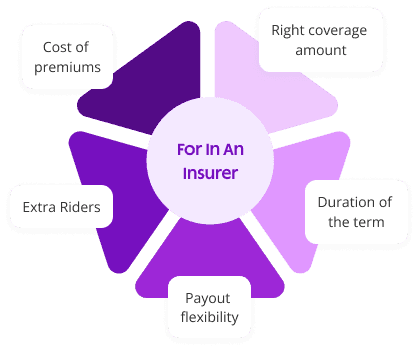
Your sum assured has to be adequate enough to fulfill outstanding loan obligations, fund important life events like kids’ education, parents’ medical needs, spouse’s retirement goals etc., and also replace your income effectively. Choose a term life policy that can secure your family’s future financial journey. Likewise, the policy term should ideally cover your working years, spanning either till your retirement or till your major financial responsibilities are completed.

Those are exactly the years when your loved ones are financially dependent on you and your untimely death can make them not just emotionally vulnerable but also financially weak. In some cases, it’s best to get the entire death benefit as a lump sum amount, whereas in certain situations, a monthly income option may work suitably well for your family’s needs at that point in time. Hence, always check for payout flexibility before deciding which term insurance to buy. Extra riders added to your term life insurance, provide additional protection over and above the sum assured for very specific cases like accidental death, critical illness etc., at a very nominal cost. In essence, make sure that the amount of premium is affordable throughout and adjusted according to your short-term and long-term goals, desired coverage amount, policy duration and premium paying terms, so that you can stay invested for a longer period of time and your family isn’t exposed to any life-altering event prematurely.

Factors To Look For In A Term Life Policy
Factors To Look For In An Insurer

Factors To Look For In An Insurer

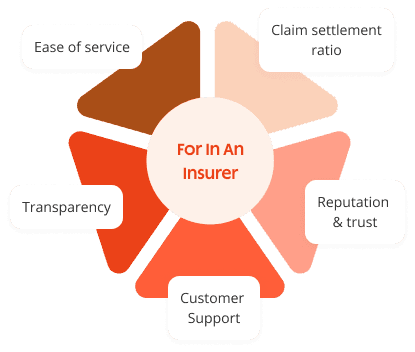
Let’s start by understanding what claim settlement ratio looks like for the best term insurance companies. A higher claim settlement ratio in term insurance indicates the insurer’s commitment to honoring claims, putting you and your family at ease, before trusting them with such an important financial decision of your life. You need to also verify and conduct background checks about the insurer.

Ensure you do a thorough investigation of the insurance company’s financials, their track record, market standing, economic performance, overall credibility in the industry, presence across the country, positive customer responses (reviews / ratings / feedback / testimonials) and past claim settlement records before buying your term life insurance policy from them. What is the digital ease of buying your term plan looking like on their platform? What kind of assistance does their customer support team offer? For example: Term insurance guides for easy understanding, jargon-free communication and language throughout so that you exactly know what you are signing up for, real-time / all-day chat / calling support, insurance advisors along the way, quick policy issuance, same-day dedicated claim processing, responsive service, discounts for purchasing online, add-on benefits, so on and so forth. How transparent does the process of buying, managing the policy, paying the premiums, and claiming benefits look to you? Based on your evaluation and assessment of the above parameters, make an informed decision when it comes to choosing the best insurance company for your term cover.

When Should You Buy A Term Insurance Plan?

The answer is ‘today’. That’s how soon you should be considering buying a term life insurance plan because the advantages of starting young in a term life policy are just so unmissable. The earlier you begin, the more benefits you get - tailored low-cost plan, affordable premiums, long-term protection, extended coverage, peace of mind for a longer period of time, financial security for big and important events (like marriage, home buying etc.) and so on. Throughout your prime working years, you can be stress-free that your family’s needs shall be taken care of if something bad happens to you. Your age and health are two main components considered while deciding your term insurance premium. So starting soon when you are in the pink of health makes your premium cost-effective in the long run.

  • Starting Early
    Age 25-30
    Starting Early
    • Lowest premiums when you’re young & healthy
    • Lock in low costs for the long term
    • High coverage at minimal expense
    • Stress-free protection from day one
  • Life Takes Shape
    Age 30-45
    Life Takes Shape
    • Protect your spouse’s long-term financial future
    • Secure home loans and ongoing liabilities
    • Increase coverage as responsibilities grow
  • Stability & Security
    Age 45-60
    Stability & Security
    • Strong financial safety net during vulnerable years
    • Protect dependents as income responsibilities peak
    • Insurance steps in right when it’s needed most

For each phase in your life, you can enjoy attractive and comprehensive coverage, while also paying less compared to someone who starts late. That is, if you want to take a home loan, in case you have dependent parents, if you are planning to get married and want to ensure your spouse’s long-term financial protection, or in case you are a young parent expecting a big expenditure in future for your child’s education / marriage, then a term life insurance policy purchased in your 20s / 30s provides the benefit of a huge sum assured (coverage amount) that can manage all these obligations, essentially without any restrictions. Moreover, starting at a young age helps you lock in a relatively low premium for a longer duration of time i.e. up to 40 years (policy term) and even more. When you are more vulnerable financially, and when your family is directly dependent on your income for their basic needs and also their future dreams, your term insurance cover takes your place with immediate effect (i.e. when you need it the most, when you are no more). Even if you are slightly older or are already in your near-retirement phase, a term life insurance plan is still the best option for your family’s goals at different stages of life. With term insurance, your family can minus the stress of managing it all by themselves without you around. Because, the payout from your term life insurance will be just around without any delay to help them on your behalf.

Our Pick for You

Step Closer To The Life You’ve Imagined With Our Featured Plan.

Term Insurance

One Plan for Many Milestones.
  • Term Insurance
  • Life Cover
  • Guaranteed Return
show moreBuilt image
(Please provide First Name, Last Name and Date Of Birth as per Aadhar Card.)
Myself

How To Calculate Term Insurance Premium Online?

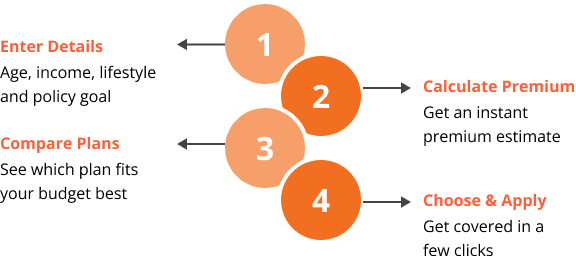
You can use the online calculator option available on Ageas Federal Life Insurance website to estimate your term insurance premium amount. This way, you can make an informed decision, after fully understanding what you need to pay, if you opt for only a basic term life policy versus what amount you should be paying additionally if you want to combine any of the riders with your base plan.

How To Calculate Term Insurance Premium Online?

After entering your basic information like age, desired sum assured, income level, gender, lifestyle habits, health data, and the policy term that you are looking at, the online term insurance calculator, with the help of actuarial frameworks, estimates the amount you need to be paying. This makes your life very easy, giving you an upfront calculation, in order to arrive at a conclusion regarding your term insurance. Using the online calculator, you can even compare several term insurance plans in one go and pick the best term insurance that’s tailored for your budget.

How To Secure Your Family’s Future With A Term Life Insurance Plan?

Beyond its advantages as an excellent insurance product, a term life policy surprises you in more ways than one, when it comes to being there for your family when you can’t be. Here’s how the best term insurance secures your family’s future.
how ToS ecure image
  • A good term insurance acts like an income replacement when your family needs it after your death to fund their day-to-day expenses and lifestyle.
  • Term life insurance payouts can be utilized to repay your home loan, personal loan, education loan etc. Liabilities need not be inherited anymore!

What Are The Payout Options Available In Term Life Insurance?

Your term insurance policy recognizes that a one-size-fits-all approach may not be ideal and beneficial, especially during claim payouts. Hence, irrespective of when the death benefit shall become payable to the nominees of the policy, the term life insurance cover offers this option - to determine the payout mode - directly to the policyholder, right at the start before they buy the term plan. The policyholder can thus choose a method that aligns with their family’s financial responsibilities. Which means you get to pick one of the following payout options that’s most convenient and suited for your family’s evolving needs. Here’s how customizing payouts works in your favour:
  • payout icon
    Lump sum payout
    Under this option, the full sum assured is paid upfront, in one go. This works best for families that need a lump sum amount for their immediate liabilities such as loan repayment, bigger expenses like that of their child’s marriage etc.
  • payout icon
    Monthly / Regular Income payout
    As the name suggests, under this, you can choose to enable smaller payments but regular income for your nominees instead of one single payment as a whole. This helps in ensuring a fixed source of earnings for the loved ones of the deceased, acting as an income replacement option for them. Unlike lump sum payout, wherein a safety corpus can be created, in regular income payout, stable financial support for a certain period of time is prioritized over wealth creation, covering the everyday expenses and short-term goals of the family members.
  • payout icon
    Combination of lump sum + income payout
    This integrates the benefits of both the payout options. Here, a portion of the sum assured is paid as a lump sum amount. The remaining part is paid as regular payouts during a chosen period, thus helping achieve the family’s immediate and long-term financial goals.

How To Apply For A Claim In Term Life Insurance?

The term insurance claim process is usually kept extremely simple, so that the family members of the deceased policyholder, who may be already grieving the loss of their loved one, can apply without any hassle or complications to avail the death benefit due to them.   Here’s what you need to keep in mind in case you are the nominee. The following steps are to be followed to claim the coverage amount if the policyholder passes away during the policy term.
Intimate the Insurance Company

Intimate the Insurance Company

Firstly, make it known to the insurer, that the individual who was holding the term life policy in their company has passed away, through the customer care executives online or at the branch directly.

Fill the claim form

Fill the claim form

Submit essential documents

Submit essential documents

Claim review and verification

Claim review and verification

Claim settlement

Claim settlement

Claim rejection

Claim rejection

Steps To Buy A Term Insurance Plan Online

Buying a term insurance plan online is very easy. There are just seven simple steps to be followed when you apply for term insurance. The entire process can be completed online without any hassles. Here’s how it works -

STEP 1 :

Understanding the agreement

The process begins with a contract / agreement between the insurer and the applicant which states that - in return for the premiums that you agree to pay over a specific duration (policy term), the predetermined sum assured shall become payable to the nominee, upon the death of the policyholder during the policy term. That is, the insurer promises financial protection to the family members if something untoward happens to the insured person within the term. This is the first step you need to take in order to understand how the process of buying the term plan and managing it works from here onwards.

STEP 2 :

Assessing your needs

This is done to determine the exact coverage amount with clarity. Calculations are made based on what your family situation looks like - their financial needs, goals, and habits and what your commitments are towards them, in the sense, your loans, your current financial status, standard of living, your future dreams for family, obligations that may arise in the short-term and the long-term and most importantly, your age, health and income level.

STEP 3 :

Choosing policy duration

Your policy term must take into consideration your age, desired sum assured, premiums you can afford based on availability of funds, your working years, your family’s dependent years on your earnings, and your retirement age goal.

STEP 4 :

Comparing term insurance plans and premiums before purchase

Analyze several aspects critically before concluding that this policy is the ONE for you. Factors you must consider: Affordable premiums, flexible payouts, long-term protection, higher sum assured, extra benefits and discounts, service delivery and customer support, previous track record of the term life policy insurers that you are considering, their claim settlement ratios, digital ease and convenience, policy features etc.

STEP 5 :

Filling application form

Submit your personal, medical and financial information truthfully. Make all declarations about your health and lifestyle with complete honesty to avoid any issues with your term insurance policy claim later.

STEP 6 :

Getting medical check-up done if required

Submit medical reports wherever required and undergo health tests as directed.

STEP 7 :

Paying premium and activating your term life insurance plan

Once the premium is paid, and the verification is done, your policy is then approved after underwriting formalities are over. The coverage is officially considered active from here onwards and your family stays protected till the end of the policy term provided all premiums are duly paid.

Term Insurance : Important Jargons Explained

  • Premium
    Premium

    The amount that you must pay regularly to the insurer to keep your term insurance coverage on.

  • Sum Assured
    Sum Assured

    The death benefit / coverage amount / claim payout that the family (nominee) receives upon the death of the policyholder during the policy term

  • Policy Term
    Policy Term

    The number of years for which your policy stays active and your family enjoys coverage / protection.

  • Premium paying term (PPT)
    Premium paying term (PPT)

    This is not the same as a policy term. PPT is the number of years you want to pay your premiums for. If you have a policy term of 40 years, and a PPT of 20 years, after the first 20 years you don’t need to pay any premiums, yet you can stay protected under the term life insurance plan for the entire duration of 40 years.

  • Nominee
    Nominee

    The individual (appointed by policyholder) who is entitled to receive the sum assured (claim amount) upon the death of the policyholder during the policy term.

  • Grace Period
    Grace Period

    The window provided (extra time given after due date) to pay the overdue premiums in order to avoid policy lapse.

  • Riders
    Riders

    Additional covers enabled optionally alongside your base term life policy for enhanced protection and wider coverage.

  • Exclusions
    Exclusions

    Specific situations / causes of death which are not included in your term insurance cover (for instance, suicide in the first year of policy).

  • Underwriting
    Underwriting

    The process undertaken to assess your risk profile; also decide your premium and eligibility based on your age, health, coverage you have applied for, income, lifestyle and your financial commitments towards your family's future.

  • Claim settlement ratio (CSR)
    Claim settlement ratio (CSR)

    The percentage of claims settled by the insurance company out of the total claims received in a year. The higher the claim settlement ratio, the stronger the insurer’s trustworthiness. Which means that greater are your chances of a hassle-free claim settlement experience with the insurance company. The CSR metric helps you gauge the insurance company’s commitment to honor your claim during critical times.

  • Return Of Premium (ROP)
    Return Of Premium (ROP)

    A feature / policy variant that you can opt for during the purchase of the term life insurance plan, in case you wish to obtain back all the premiums paid till maturity, if you outlive the policy term.

  • Revival Period
    Revival Period

    The window (maximum time limit) provided to reactivate a term life policy that has lapsed due to outstanding premiums.

Ageas Federal Life Insurance Shield

AGEAS FEDERAL LIFE INSURANCE

Endorsed by Life Insurance Experts


Ageas Federal Is A Trusted Life Insurance Partner

At Ageas Federal Life Insurance, we are dedicated to creating meaningful insurance solutions that help individuals build a secure and confident future. With over a decade of experience, we offer a wide range of plans across protection, pension, savings, investment, annuity, and health, designed to support evolving financial needs at every stage of life.

FAQ’S related to Term Insurance Plans

Term insurance is the most simple and straightforward form of life insurance, which is not only affordable, but also highly preferred and considered essential by insurance experts for its coverage size. In case something happens to you during the policy duration (policy term), the term life insurance plan promises financial security to your loved ones. Since term life policies are primarily designed to act as financial instruments for family protection and not high-risk market-linked investments yielding attractive returns, there is generally no payout at maturity if you survive the term (unless you opted for a term life insurance with ‘Return Of Premium’ plan). The key highlight of any term insurance policy is its ‘low cost of premium for a high coverage amount’ benefit. So, a 25-year-old young professional, with clean health records and a non-smoker status, can buy a Rs. 1 crore term insurance plan at an annual premium of just a few thousands. That is, for as little as Rs. 800 - Rs. 1,000 per month. If you pass away during the term, the lump sum payout from your term insurance cover protects your family members from financial distress, especially because your income and earnings are no longer available to them. Your dear ones can use this death benefit to repay your loans, fund their dreams, afford major milestones like higher education, marriage, etc., invest in other financial instruments for a better future, maintain their standard of living, live with dignity in their old age / retirement period, all this and more while keeping you in their memories for your one wise decision, your sheer commitment to secure their future with the best term policy. Often requiring just basic documents and a few medical tests based on your age and health / lifestyle factors, online term insurance covers are super easy to understand, buy and claim. You can also customize your term insurance coverage for comprehensive protection by adding riders like accidental death benefit, critical illness cover, waiver of premium, and / or disability cover.

So, what do you think makes the term life insurance plan a smart financial choice for policyholders? Well, the answer is simple. Multiple tax benefits!

  • Section 80C - Premiums paid towards your term insurance plan are eligible for tax deductions (up to Rs. 1.5 lakh annually).
  • Section 10(10D) - The death benefit / payout (sum assured paid to the nominee) is completely tax-free.
  • Section 80D - If you have added health-related riders like critical illness or disability cover, premiums for those may also qualify for deductions under this section.

For example, if you pay Rs. 20,000 towards your term life insurance as annual premium, this amount can be claimed as a deduction under Section 80C, which reduces your taxable income. If the unfortunate event of death happens during the policy term, and your nominee receives Rs. 1 crore sum assured, the entire payout is tax-free in their hands

When you buy a term insurance policy, keep these documents handy to ensure that you have a stress-free experience and quick policy issuance as you apply for the coverage you desire. You are expected to provide accurate information in these documents. If any of these documents or details provided in your application are found to be forged and invalid, your claim can get rejected later.

  • Identity proof (Aadhaar, PAN, passport, voter ID)
  • Age proof (Birth certificate, Aadhaar, driving license)
  • Address proof (Utility bills, Aadhaar, passport, rent agreement)
  • Income proof (Salary slips, Form 16, ITR, bank statements [to justify the sum assured you are applying for])
  • Medical reports (Depending on your age, occupation, health declarations made, and sum assured mentioned in the application, the insurer may want you to undergo medical examination or reports may have to be submitted as required)
  • Photographs (Passport-sized photos for records)

Yes, you can buy multiple term insurance policies from different insurance companies. This allows you to diversify benefits from several term insurance covers while also scaling protection with increased sum assured from multiple plans. However, make sure to disclose about each of your term life policies to all your insurers because insurance companies generally tend to check the overall eligibility of the policyholder to ensure alignment of your income with your desired total coverage amount. Multiple term insurance covers means more flexibility for the policyholder because you need not overpay or overcommit at an early age. Instead, your term life insurance covers can be structured based on your financial responsibilities at different life stages. Your nominees can claim payouts from all policies you hold at the time of death, thus leading to lump sum benefits helping in their immediate and long-term financial relief. Example: Anuradha, a 28-year-old non-smoker, healthy female, buys a Rs. 50 lakh term insurance plan, with the goal of providing financially for elderly care expenses of her parents, upon the likelihood of her untimely death. At 35, after marriage and taking a home loan, she buys an additional Rs. 1 crore term life insurance policy to provide coverage for her spouse and loan obligations. Later at 42, she adds another Rs. 50 lakh term insurance cover for future education expenses of her 2 children. Currently, Anuradha holds three policies: Rs. 50 lakh + Rs. 1 crore + Rs. 50 lakh = Rs. 2 crore total cover amount. If Anuradha passes away during the policy term, nominees of Anuradha’s term insurance covers can claim death benefits from all three plans mentioned above, provided full disclosures were made at the time of their purchase.

During purchase of a term life policy, your premium is usually determined after assessing your risk profile, which is calculated on the basis of your age, your current health status, medical conditions if any and lifestyle habits that are impacting your health. If you were a non-smoker and a non-drinker back then when you had originally bought the term insurance, your risk profile would have been estimated differently compared to what your current risk profile is after developing those habits. Good news: Your premium does not automatically change immediately based on the lifestyle habits you adopt. Term life policy gives you enough predictability and long-term affordability by locking in the premium determined for you at the start of the tenure (provided you pay it regularly). In other words, your current policy with the insurer remains intact without any modifications even after you have developed these habits. What’s ideally recommended?: You are expected to inform the insurer about significant and major developments to your health or anything to do with your changed lifestyle, either during periodic medical reviews (as and when required), policy renewal or while making a claim to the company. It is considered to be an important responsibility at your end because if something happens to you and your untimely death gets connected to your lifestyle changes (smoking, drinking etc.), your family’s claim for the payout can be denied or delayed depending on the case and the investigation findings. Therefore, honesty is always the best policy when it comes to term insurance. In case you were a smoker / drinker right from the start but had informed the insurance company otherwise (during purchase of the policy), this amounts to non-disclosure (hiding of such crucial information) which again leads to several complications during the claim, most of them putting your family’s peace of mind, protection, finances and future at a huge risk. This, in turn, destroys the whole purpose of why you had purchased a term life policy in the first place. In short: Being transparent at all times ensures that your family doesn’t have to go through any such stress later. Upon intimation of your newly-developed habits and health changes, your insurer may reassess your risk profile. You can also expect your premium to increase accordingly.

Many companies often enable group life insurance plans for several of their employees working in the organization as a part of employee benefits. However, the most important question here is - Are group life insurance covers the same as personal term life insurance plans? Not really! While it is true that a company-provided group insurance is indeed valuable and comes with its own advantages, you can’t ignore the fact that it is directly linked to your employment with the organization. Meaning, when you exit from the organization, switch to another role or another company or if you choose to retire, then your coverage can be immensely impacted. Which is, when you actually need your policy to run the show, there is no surety that you will be covered under the corporate plan. The group cover ends with your employment in the organization, which is obviously not the case with your individual term insurance. Your policy stays active for the entire term you opted for as long as you pay the premium regularly without any lapses. Your individual term life policy has nothing to do with where you work, thus giving you complete control over the coverage.

Moreover, in an individual plan, you get to choose the sum assured for your family. Group plans only provide basic coverage and may not be sufficient enough for your specific needs and financial obligations. For instance, a corporate life cover plan may offer a Rs. 10-20 lakh coverage while your personal term insurance may actually provide a Rs. 1 crore sum assured or even Rs. 2 crore coverage based on your age, income level and financial responsibilities.

Along with your individual term life policy comes full flexibility to customize the coverage as per your choice and your family’s goals. You can choose a premium paying term that aligns with your cash flow situation, add riders to enhance the coverage for specific events like accidental death, critical illness etc., and even decide the policy term with the number of years you want your family to be covered under the plan. These features for personalization may not be available under the corporate plan which you are added to by your employer.

Having a workplace life cover is great, but it cannot be the only financial cushion you rely on for your family’s well-being tomorrow. An individual term life insurance means protection that is tailored, lifelong and sufficient enough, irrespective of where you are in your career.

Yes, absolutely. Here are 10 major disadvantages of delaying the purchase of your term life insurance policy:

  1. Reduced health advantage - Diabetes, chronic heart ailments, hypertension and other such health illnesses develop as you grow older. The insurance company considers the following parameters while approving the application and calculating your premium for term insurance: How risky are you to insure? Are you eligible for term life policy? How much premium will you have to pay considering your age, income and your coverage? What’s the probability of you making a claim? Should the company approve your application based on the above findings?
  2. Risk of lifestyle changes - Once you develop habits like smoking, drinking alcohol etc., they become a part of your medical history.
  3. Higher premiums - Your risk profile changes with your growing age and deteriorating health. So, you need to now pay more for the same coverage compared to what you would have paid if you had started in your 20s.
  4. Decreased policy duration - Starting in your 20s and 30s guarantees protection for your loved ones for a longer duration (40 years+), whereas, starting in 40s and 50s restricts your family’s protection for a limited 10 to 20 years time frame, leaving them financially vulnerable.
  5. More exclusions - The higher the risk, the more exclusions your policy will have. So, in a way, if you are waiting to buy term insurance, then you are reducing your options for coverage.
  6. Costlier extra riders - One of the main advantages of term life insurance is - the winning combination of ‘early entry age x affordable premiums x higher sum assured’. Add-on riders aren’t as cost-effective as they are if you buy them later.
  7. Lower sum assured due to unaffordability - In term life insurance, the premiums rise sharply when you don’t start at the right time. Which means, a term life policy for a higher sum assured, becomes way too expensive for you to comfortably afford it for your family’s lifestyle needs.
  8. Poor financial decisions - Because of your one miss i.e. delaying the purchase of your term insurance, your cash flow gets affected later. As you start paying higher premiums, the strain on your finances increases. Not just that, the financial freedom to spend on your current needs and invest in other financial instruments reduces.
  9. Loss of mental peace - Because of all the above reasons, your financial situation causes immense mental strain. Higher premiums, lower sum assured, risk of exclusions, expensive riders, health and lifestyle disadvantages and your family’s unsecured milestones can keep you extremely stressed at all times.
  10. Threat of family’s exposure - When you postpone buying term insurance, your family stays unprotected till the policy becomes officially active. If something happens to you regrettably, your family may have no monetary support to lean on.

Regular premium payments are an integral part of your term life insurance policy. Hence, failure to pay these premiums consistently (according to the premium paying term decided during the purchase of the policy), causes your term insurance coverage to become invalid and lapse. Not just that, your family loses the financial shield that you so painstakingly built for them to benefit from in the future in your absence. In case of untimely death of the policyholder during this lapsed period, the family has no right on the sum assured and the insurance company shall not be liable to pay any death benefit to them. Unlike other investment plans, the term insurance covers offer no maturity value i.e. if your policy lapses, you get nothing in return - no refund of the premiums paid till date (Want a pro tip to never miss a payment? You can set up an auto-debit! Alternatively you can also schedule alerts / reminders for these payments). However, most insurance companies, including Ageas Federal Life Insurance, provide a grace period after the due date for policyholders who missed paying their premiums, so that you can at least have a second chance at retaining your coverage like before and nothing changes thereafter. Yet, if you still don’t clear the pending premium payment(s) within this window, then your policy is interrupted midway. And it lapses with no more benefits being rendered for your family. In some cases, you may be allowed to reinstate or revive the policy, provided it is within a specific time frame (usually 2-5 years) as required by the insurer. This can be done by paying all outstanding premiums due till date (with interest) and by undergoing a new medical test if asked for by the company. So, even if you are dealing with any financial constraints, you can still restore the term life policy in this manner.

Term insurance plans generally cover most types of deaths. Natural causes of death and accidental deaths both.

What's included?
  1. Natural causes: old age-related, health complications, listed illnesses etc.
  2. Accidental causes: road / rail / airline accidents, occupational hazards - industrial incidents etc. (Benefit under base term insurance + Accidental death benefit rider if opted*)
  3. Coverage for critical health issues like cancer, kidney failure and cardiac arrest: That is if these conditions were not pre-existing and undisclosed at the time of purchase. (Benefit under base term insurance + Critical illness rider if opted*)
  4. Death due to homicide / assault (unless the insured / nominee found complicit in the crime)
  5. Death outside India provided all relevant documents are submitted to the insurer during processing of the claim.

(*The policyholder has an option to add such a rider to enjoy add-on benefits and wider protection for specific cases.)

What’s not included?

There are also some exclusions you must be aware of before purchasing term insurance.

  1. Death by suicide in the 1st year of the policy not covered. There’s a 12-month waiting period from the date of policy issuance.
  2. Death due to participation in any illegal activities, self-inflicted injuries, or substance abuse excluded.
  3. Non-disclosure of critical health information, incorrect age, misstatement of financials, hiding of medical conditions, and false information about lifestyle habits: If any of these cases are found upon investigation by the insurer, then the claim is rejected.
  4. High-risk adventures (like mountaineering, private aviation, motor racing etc.) are not covered, unless informed to the insurance company during the purchase of the term life insurance plan.

A Rs. 1 crore term life insurance plan is one of the most preferred coverages for many who are wanting to buy term life insurance. Reason being, it offers a very comprehensive payout (lump sum) for several categories of policyholders like married couples, young working professionals, families planning for their child’s future, middle-aged individuals with home loan commitments etc. It ensures a great amount of stability considering the huge sum assured and the relatively low premium that is required to keep the Rs. 1 crore term life policy active.

Here are the steps to buy a one crore term plan:

  1. Assess if your income level matches the criteria for the sum assured you have chosen
  2. Check your eligibility i.e. your age (typically between 18-65 years)
  3. Compare different types of term insurance policies online, and the rider options that you would like to add to your base plan
  4. Choose the policy term and the premium paying term to evaluate the premium amount using the Rs. 1 crore term insurance calculator available online
  5. Submit your income proof to the insurance company along with your online application to justify the coverage you are expecting
  6. After understanding your risk profile and reviewing your age, health, medical, lifestyle and financial declarations, the insurer may ask you to undergo a medical check-up
  7. Your application gets approved after verification → you pay the premium → policy is issued → you are sorted with absolute peace of mind that your family is now in safe hands → upon your unfortunate demise, the term insurance (Rs. 1 crore claim payout) shall serve as a pillar of strength to your loved ones

To know the answer to this question, you must firstly understand that the key factor which differentiates term insurance from a whole life insurance cover is - As a policyholder, what is your objective? Do you want only risk protection? Or do you want protection plus savings? Many experts recommend buying a term life insurance policy first and then adding more investment instruments to your kitty in order to build a wealth corpus. Each financial product comes with its own pros and cons. A pure term life insurance policy is only meant to provide protection to your family upon your death and it’s not designed to primarily help create wealth alongside. So, there is no maturity benefit that you get after the policy ends.

Answering the most common question every to-be policyholder has regarding term insurance - ‘Will I get my money back if I survive the policy term?’ Let us reiterate: No, there is no refund possible for any money paid - by way of premiums over the years - during the policy term in case you survive (unless you had opted for a term insurance with Return Of Premium variant at the time of purchase). Under this feature, you can get back all your premiums (minus the taxes and the rider cost) paid towards this term insurance plan. However, it is worthy to note that ROP plans are slightly costlier in comparison to the regular term insurance plans with no return of premium.

In traditional policies, there is no payout if the policyholder survives when the plan ends. If you still expect a lump sum when the policy matures, you can definitely go for a term insurance cover with Return Of Premium (ROP). For example, under a certain ROP plan, you pay Rs. 20,000 as annual premium for 30 years (policy term). At maturity, if you outlive this term, you may get back Rs. 6,00,000 as a lump sum. Remember, affordability is kicked out the moment you go for the ROP feature, as ROP plans can sharply push the premiums by 2X-3X. Also, the returns from ROP plans (example, say after 30 years policy duration) cannot be equated with the attractive returns from other investments / financial instruments like mutual funds, fixed deposits etc.

While ROP plans are ideal for those who do not prefer ‘no return’ policies, according to various experts, the combination of -

  • paying lower and affordable premiums for a traditional term insurance plan with a higher sum assured and
  • investing the extra amount (which you just saved by not opting for ROP) in some other financial tool like an SIP* Generally speaking, it is a wiser financial decision to make, that can yield better returns in the long run.

*This information is for general understanding of readers and not to be considered as financial advice. Please consult a qualified advisor before making any investment decisions

The minimum entry age limit to buy term insurance is 18 years. And the maximum entry age typically is between 60 and 65 years on most insurance platforms. The whole point is to start financial planning early, when age and health both are in your favour. Premiums are way more affordable then and the coverage amount too is attractive and adequate enough for your family’s lifestyle needs. You can enjoy more flexibility and control as insurers categorize your profile under low-risk potential/ low-chances-of-claim cohort. The maximum maturity age (the age limit till when you can stay protected) can range between 75 and 85 years (this is a more common exit age range), however some insurers even allow up to 99 years of age.

Certain details in your term insurance policy can be changed even at a later point in time like nominee information (updation / change possible anytime), contact information (phone number, email, address etc.), premium payment mode (move from monthly to quarterly, or half-yearly to annual or vice versa - switch as you like), extra riders (addition / removal possible at the time of renewal), and sum assured (top-up coverage). However, primary information like your age, lifestyle declarations (smoker status), health conditions (pre-existing) and occupation cannot be altered retrospectively. It is expected that you must provide correct and honest information transparently right at the time of purchase of term insurance.

A general rule is to buy a term insurance plan with coverage which is almost 10-15 times your annual income. You can even use another approach that’s more accurate to arrive at the right sum assured (adjusted to your family’s financial obligations) by taking into consideration -

  • Your current income and lifestyle needs
  • Outstanding loans and EMIs
  • Major future financial responsibilities
  • Present investments and savings

Sample illustration: Your annual income is Rs. 12 lakh, and you have an outstanding home loan of Rs. 50 lakh. You think you may need Rs. 50 lakh in future to fund your child’s education abroad. In such a scenario, it is recommended that your coverage should ideally be around Rs. 1.5 crore to Rs. 2 crore for your family’s financial steadiness in your absence.

The first step in a sound financial plan is buying term insurance. While starting early has many pros for you to seriously consider buying the top term life insurance cover, even senior citizens can purchase a term insurance policy. However, since age and health, both are not in your favour, entry into term life insurance is usually capped around 60-65 years. Some insurers extend this to even 70 years. In any case, when you start as a senior citizen in term life insurance plans, your coverage term reduces significantly and is much shorter compared to a young policyholder who enjoys long-term peace of mind. Your policy term can thus ideally range anywhere between 10-20 years. That’s not the only difference. Let’s talk about premiums. The cost of premium for a senior citizen is way more than what it is for a policyholder in their 20s, 30s and 40s. With old age, health risks go up enormously and the risk of mortality also increases for the individual. Considering this, the insurance company charges a relatively higher premium to compensate for the risk of claim that it undertakes in your specific case. Your eligibility and premium change depending on the critical health conditions you are suffering from.

So, as an older buyer of the term life insurance plan, here’s what’s in it for you - Examples:

  1. A 62-year-old non-smoker applying for a Rs. 50 lakh term life policy may have to pay Rs. 85,000 - Rs. 1,10,000 as annual premium. The same cover for a 35-year-old non-smoker may cost only Rs. 8,000 - Rs. 12,000 per year.
  2. A 65-year-old smoker may be charged Rs. 1.5 lakh to Rs. 2 lakh per year for a Rs. 50 lakh term life insurance policy (In some cases, they may be denied coverage altogether.) Whereas a 40-year-old smoker may still get the same cover for about Rs. 25,000 - Rs. Rs. 35,000 premium per year
  3. A 65-year-old applying for term insurance may only get a policy that runs for 10 years (till age 75). Their application for a 30-year plan like someone in their 30s gets rejected.
  4. Some insurers may allow coverage strictly till age 80 i.e. if a 62-year-old applies for a term insurance cover, they may be offered a policy with the duration of only 18 years, no matter how much they are willing to pay as premium towards the term life insurance plan.

Should you still consider buying a term plan if you are an older person?

Yes absolutely. Here’s why!

  1. Older people buy term insurance to help family members with the repayment of any outstanding loans upon their death
  2. If you have a person who is dependent financially on you, you can safeguard their financial journey with income replacement from the term insurance claim payout
  3. A term life policy supports senior citizens in estate planning and legacy building as their heirs can manage wealth transfers smoothly with the tax-free lump sum. From enabling an option for debt-free inheritance to funding the future generations’ dreams, term life insurance for senior citizens can be viewed as a powerful tool here

Most senior citizens don’t have 30-40 years of income dependency. Also, there is a significantly higher claim probability in old age. So, a limited-term cover, even if it’s costlier, makes sense for many older buyers.

What are some alternative options for senior citizens?

Whole life insurance cover, pension plans, retirement annuities, and health and critical illness insurance. Ageas Federal Life Insurance does provide term insurance to older individuals. Before buying a term plan, read the policy documents carefully for policy limitations, capped durations and maturity ages.

Ideally, in a traditional sense, term insurance cannot be looked upon as an investment option because if you outlive the policy term, you generally gain no returns from the term life policy. A term life insurance plan acts like a protection tool, helping to keep the financial stress of your loved ones away, when you are no longer around to safeguard their future.

Term life insurance: A financial cushion for the family upon the death of the life assured. Is that all to it? No. A term insurance cover is considered by industry experts as one of the best financial decisions you can ever make for your family because -

  • it aligns a huge sum assured with a really low premium
  • it guards your assets as your family need not be in a pressurized state later to sell their gold, property etc. in order to survive after your death
  • it even supports their financial journey ahead if they choose to invest the remaining funds elsewhere (like mutual funds) after paying off loans and other financial obligations

You can think of term insurance as a stepping stone to your future financial security, powered by a token of care (premium) committed consistently (premium paying term) over a predetermined period of time (policy term) for a large sum (coverage). In simple terms, a term life insurance plan is not an investment product. But the biggest return it promises (apart from the coverage amount after the insured person’s death) is the peace of mind throughout the policy term that if something miserable were to happen to your life, your family won’t be helpless and exposed, struggling for money. Your term life policy stands tall to guard them when you cannot!

Let's look at an example: Saif is thinking of investing 1 lakh rupees every year towards an endowment policy.

Expert tip: Saif - instead of utilizing his entire budget / funds towards the endowment plan - should consider using Rs. 10,000 first, to pay as annual premium towards a term life policy. Remaining Rs. 90,000, if invested in mutual funds, over the next 20 years can yield better returns for Saif. This way, Saif can get dual benefits: Protection plus savings leading to wealth creation for his family, when they would need it the most.

Ideally, the perfect time to buy a term insurance cover is NOW. In other words, as early as you can. Because younger age = a healthier you, which means lower premiums and early lock-in benefits for your term life policy before possible health changes at a later point in time. For instance, at age 25, you may pay just half the premium compared to what you may have to pay in your 35 years of age in case you choose to start late. You can consider purchasing a term insurance cover even in your 20s as soon as you start earning. This ensures that your future plans (with respect to marriage, housing loan, children and retirement) are also secured as your commitments increase with age. Your application for term life insurance is more likely to be approved at a younger age due to easy eligibility and wider coverage without the fear of rejection due to medical reasons. So, to protect your people from uncertainties in future, buy a term plan today. The earlier, the better - even for a stress-free approval.

If you are a young earner and still don’t hold a term life policy, you can consider buying one around these milestones such as -

  1. a huge salary jump,
  2. marriage plans are around the corner,
  3. you are taking big loans,
  4. you are already a parent or planning for a child
  5. you are in your 30s and considering early retirement (i.e. around 45 years of age)
  6. you are a key stakeholder in any venture
  7. you have elderly parents dependent on you

Are you ‘the sooner, the smarter’ kind of person when it comes to term life insurance? Kudos! You have indeed made a wise choice for yourself and your loved ones!

Yes, 100%. Smoking has a direct impact on your term insurance premium. While applying for term insurance, you are expected to make some lifestyle declarations which include your smoking habits, alcohol consumption and tobacco chewing. These habits are proven to affect your health adversely, increasing your chances of respiratory conditions, heart diseases, cancer and other critical illnesses. Which means, the insurer's risk goes up when the probability of your claim rises. Hence, you have to pay a higher premium in such cases.

Term insurance premium for individuals with smoking habits is definitely on the higher side compared to the premium for non-smokers, even if the sum assured, policy term and other factors like applicant’s age are same.

Pawan, a 30-year-old non-smoker may have to pay Rs. 8,000 annually for a Rs. 1 crore term insurance cover Vikas, a 30-year-old smoker may have to pay as high as even Rs. 14,000 annually for the same Rs. 1 crore term insurance plan

Key points to remember:

  • Be honest. Smoking kills. Not just you, but also your family’s peace of mind during the claim. So if you think you can hide your smoking habit from your insurance form, you are absolutely wrong. When discovered later during investigation, the claim often stands rejected.
  • Smoking occasionally, smoking just a few times randomly, casual or social smoking - all such kinds of smoking are considered in insurance policy clauses. Do not be your own judge. Make these declarations upfront in your application.
  • In certain cases, you can be reclassified as non-smoker if you have quit the habit and have maintained the same status for a few years. Medical tests are required for confirmation.

Yes, you can buy term insurance online on several platforms that do not require you to undergo a medical test before applying. A medical test may not be necessarily mandated in those situations where the applicant is young, healthy, and has chosen a relatively smaller sum assured. In many such cases, an individual - who is supposedly in their 20s or early 30s, with a self-declared clear health status and a low-risk medical history running in the family - applies for a coverage ranging between Rs. 25 lakh and Rs. 50 lakh, and the insurance company may have no qualms in approving such an application, even without their medical test

On the other hand, let’s consider an example where the applicant is in their 40s, with lifestyle habits like smoking and drinking, opting for a higher coverage (Rs. 1 crore+). This applicant also has a family history of critical conditions. In such scenarios, the insurer almost always wants the applicant to undergo a medical check-up.

Advantages of ‘no medical test’ policies: Hassle-free experience, direct policy, quick approval, easy application process, minimal paperwork, no hospital visits, no waiting time - JUST CONVENIENCE

Disadvantages of ‘no medical test’ policies: Higher premiums, more risk for insurer - so lower cover amount, more chances of claim rejection

Pro tip: Medical tests provide better accuracy in policy issuance and premium determination. Even if your online term insurance doesn’t require you to go for a check-up, ensuring that you submit absolutely honest health information is critical during the application stage. Non-disclosure often leads to claim rejections later. For a hassle-free claim settlement, it is always recommended that you provide the insurer with all the necessary details and keep complete transparency regarding your health and medical history while buying any term insurance online. Otherwise, it can get extremely stressful for your family later, when you are no more, to claim the sum assured, because if the insurer discovers any mismatch in the information provided by you at the time of application - such as incorrect age, health problems, lifestyle disclosures and so on, the company can delay or deny payout. To secure peace of mind for your loved ones, maintain accurate information in every step of your term insurance journey - be it a medical test policy or a no medical test policy.

When you are young, you are usually healthy, with no such critical conditions which generally affect your risk profile. However, as you age, your health status changes and deteriorates, increasing the chances of a claim when viewed from the insurer’s lens. Premiums are basically scientific calculations made on the basis of the relation between your age, health and coverage risk. Generally speaking, a 25-year-old individual, non-smoker, healthy male is viewed as less likely to pass away in the near term in comparison to a 50-year-old individual, diabetic, and social drinker. So, the key drivers for a higher premium are age, increased health risks, and shorter premium paying term. For example, 25-year-old Rahul may pay just Rs. 7,000 as annual premium towards a Rs. 1 crore term life policy. The same term insurance, in case Rahul starts later i.e when he turns 35 years - could cost Rs. 12,000. And if Rahul buys that term plan when he is 45 years old, the annual premium might just jump to anywhere between Rs. 25,000 and Rs. 30,000.

The calculation for a term insurance premium is done keeping in mind a mix of different parameters. The three main factors which are considered to calculate the premium for your term life insurance plan are your personal factors, your health & lifestyle factors and policy-related factors. This is done to understand your risk profile better and arrive at a suitable term life insurance, policy term and premium amount, which can work well for your specific budget, financial goals, life stages, family needs and your unique requirements for financial protection in the event of uncertainty.

Let’s look at twelve key factors which influence the calculation of premium for your term life policy:
  1. Age of the applicant:

    Your age is the most important component considered while deciding your premium. The younger you are, the fewer health risks you face. The earlier you start, the less you pay. The sooner you buy a term insurance cover, the longer you stay protected.

  2. Cover amount:

    If you are looking at a higher sum assured, then you may have to also pay a higher premium

  3. Policy term:

    Longer policy duration = higher risk for the insurer = hence, higher premiums. However, you can benefit from the extended protection that you get for your loved ones i.e. coverage for more years, in turn aligning with your long-term goals for them.

  4. Pre-existing health conditions:

    Existing health issues impact your premiums to a major extent as they increase the risk element for the insurance company.

  5. Medical history:

    Your insurer assesses your health risks by examining your medical test reports and your family history of chronic and hereditary illnesses (diabetes, cancer, heart conditions etc.) to accordingly determine your premium. Even obesity causes your premium to increase.

  6. Lifestyle habits:

    Your lifestyle habits influence your health, which in turn, impacts your term insurance premium. Submitting all details upfront regarding your smoking and drinking habits and high-risk hobbies like adventure sports lower the risk of rejection later.

  7. Occupation:

    People in high-risk jobs like mining, construction and aviation, and those in professions involving higher levels of stress may have to also pay higher premiums. Moreover, your income level needs to align with your desired sum assured i.e. coverage amount expected. The insurance company may run a check to determine your occupational stability. High-stress professions too can increase your premium.

  8. Extra riders:

    Choosing add-on riders to enhance protection increases your premium.

  9. Gender:

    Generally speaking, as per statistics, women tend to live longer than men. Hence, if you are a woman applying for term insurance, your premiums are slightly lower for the same sum assured, in comparison to that of a man’s policy.

  10. Mode of premium payment:

    Annual premiums are slightly cheaper compared to monthly installments and half-yearly premium payments.

  11. Location:

    If you are residing in a high-risk geographical area (For example: highly polluted zones), then your premiums can be slightly costlier.

  12. Underwriting results:

    Depending on the underwriting assessments, if any piece of information found in the medical reports or otherwise, puts you in a high-risk category for the insurer from a claim probability perspective, then the insurance company may choose to increase your premium or even reject your application altogether.

Premiums are not random figures. These are customized calculations made to ensure that your premium is adjusted to suit your life stage, type of term insurance, job risk, coverage amount, health issues, risk profile, lifestyle and choice of policy term.

While there’s no one right answer to this question, the Rule Of Thumb formula, as advised by most financial planners, is to start early and stay invested for the longest cost-effective policy term. This way, you can unlock maximum sum assured with a coverage that stays active →

  1. Up until you stop earning i.e. till your retirement age, Which brings us to the equation Recommended Policy Term = Your Planned Retirement Age Minus Your Current Age, generally speaking.
  2. Till such time as all your major commitments are fully supported, Which means, your home loan, kids’ higher studies and such bigger liabilities are well-managed in your financial plan.
  3. For such duration as required by your dependents to become financially independent, Which is, if your kid is 7 years old today, you should ideally go for a 15-20 year policy term because your child may become self-reliant between their 22-27 years of age.

Most policyholders tend to have opted for a duration that covers them until their family no longer depends on their earnings; their major financial responsibilities are fully taken care of. That is, till the insured person is 60-65 years of age. Follow these numeric examples to understand how a policy term impacts your coverage and premium clearly.

Insured person’s details Sum assured (Rs.) Suggested policy term Premium – Scenario 1
– Scenario 2
– Scenario 3
Impact
Shiv (25), young professional, retirement age goal - 60 years 1 crore 35 years
  • 20-year term (till age 45): Annual premium = Rs. 8,000*
  • 35-year term (till age 60): Annual premium = Rs. 10,500*
  • 40-year term (till age 65): Annual premium = Rs. 14,000*
*Sample figures for representational purposes only. These are not based on actual calculations. Not to be considered as financial advice.
Coverage till 55–60 years of age ensures that Shiv’s family is secured completely during his peak working years, including debt repayment support if he passes away during the term.

Longer term may result in higher premiums for Shiv but it also provides financial security to his family for more number of years.
Tanya (40), young mother and middle-aged office-goer, retirement age goal - 65 years 1 crore 25 years
  • 15-year term (till age 55): Annual premium = Rs. 18,000*
  • 20-year term (till age 60): Annual premium = Rs. 23,000*
  • 25-year term (till age 65): Annual premium = Rs. 30,000*
*Sample figures for representational purposes only. These are not based on actual calculations. Not to be considered as financial advice.
Coverage till 65 years of age ensures sufficient backup for Tanya’s child (son, 4 years, today) to complete education and be on his own or financially independent i.e. not reliant on Tanya’s income. It also becomes a safety net for Tanya’s spouse in future, when he would be prepping for his retirement, if something happened to her later in that period of time.

Starting late means higher premiums again, but think of the term insurance cover as a wealth guard for those dependent on Tanya.
Rajshekar (45), self-employed, late career boost, retirement age goal - 55 years 1 crore 10 years
  • 10-year term (till age 55): Annual premium = Rs. 15,000*
  • 15-year term (till age 60): Annual premium = Rs. 20,000*
  • 20-year term (till age 65): Annual premium = Rs. 28,000*
Coverage only till 55 years of age (in this case, a shorter policy term) puts loved ones at risk during crucial years, especially when they are dependent on Rajshekar’s earnings for several key events such as his daughter’s (currently 12) wedding expenses. elderly care cost for Rajshekar’s parents (aged 70 and 65 respectively), and an outstanding loan for his house Starting late in term life insurance has its own disadvantages. Although shorter terms are comparatively cheaper, in this specific case, a Rs. 1 crore term insurance cover for 10 years duration leaves Rajshekar’s family unprotected and exposed to financial liabilities sooner (i.e. if something unfortunate were to happen to Rajshekar after the policy term ended). So you can conclude that a longer term means greater peace of mind

Disclaimer

This brochure gives only the salient features of the Ageas Federal Life Insurance Saral Jeevan Bima. It uses easy-to-understand language to explain the features. Your plan is governed only by the full legal terms, conditions and exclusions as contained in the policy document. Please read the policy document for more details. Ageas Federal Life Insurance Saral Jeevan Bima is A Non-Linked Non Participating Individual Pure Risk Premium Life Insurance Plan (UIN: UIN 135N079V01). There are no riders attached to this plan. The product is underwritten by Ageas Federal Life Insurance Company Limited (IRDAI Regn. No 135; Corporate Identity Number (CIN) - U66010MH2007PLC167164) having its registered office at: Ageas Federal Life Insurance Company Limited, 22nd Floor, A Wing, Marathon Futurex, N. M. Joshi Marg, Lower Parel – East, Mumbai – 400013, Maharashtra . Website: www.ageasfederal.com. Toll-Free: 1800 209 0502.Trade Logo displayed above belongs to IDBI Bank Limited, The Federal Bank Limited and Ageas International Insurance N. V. and used by Ageas Federal Life Insurance Company Limited under license from respective partners. Ageas Federal Life Insurance Company Ltd. does not assume responsibility on tax implication. Ref. no. 20290/SJB/ENG/Print-PB/Dec24

This brochure gives only the salient features of the Ageas Federal Life Insurance iSecure Plan. It uses easy-to-understand language to explain the features. Your plan is governed only by the full legal terms, conditions and exclusions as contained in the policy document. Ageas Federal Life Insurance iSecure Plan (UIN 135N088V02) is a Non-linked, Non-participating, Individual, Pure Risk Premium and Savings Life Insurance Plan and no benefits other than those indicated in this brochure are payable. This product does not participate in the profits of the Company. Substandard lives will be charged extra premium. This product is underwritten by Ageas Federal Life Insurance Company Limited (Regn. No 135; Corporate Identity Number (CIN) – U66010MH2007PLC167164) having its registered office at: 22nd floor, A wing, Marathon Futurex, N.M. Joshi Marg, Lower Parel – East, Mumbai – 400013, Maharashtra. Ageas Federal Life Insurance Company Limited does not assume responsibility on tax implication. Please consult your own tax advisor to know the benefits available to you. Tax Benefits are as per the Income Tax Act, 1961 and are subject to changes in the tax from time to time. Trade logo displayed above belongs to The Federal Bank Limited and Ageas Insurance International N.V. and used by Ageas Federal Life Insurance Company Limited under license from respective partners. ARN: 20279/iSP/ENG/Print-PB/Nov24

Dos Don’ts
Buy a term life insurance policy asap (at a younger age) Delaying term insurance
Stay fit, stay healthy Not disclosing about pre-existing health conditions / lifestyle habits during purchase of the plan
Keep nominee records updated at all times in the policy forms and documents Choosing an inadequate coverage amount and not aligning your policy term with the actual obligations / responsibilities at your end i.e. for how long do you and your family need financial security under the policy? This is an important decision you need to make when you are buying term insurance. Because a very long policy term without proper financial planning will only increase your premium without providing real value.
Make sure that your sum assured is sufficient enough for your family’s standard of living – not just today but also tomorrow – considering the bigger events which are expected to come their way. Add relevant riders for conditions that you think are absolutely necessary in your case. Missing or skipping premium payments
Pay your premiums regularly without fail Not customizing the term life policy prudently
Opt for annual premiums if you can Paying premiums monthly, quarterly or half-yearly instead of annually
Compare term insurance plans before you buy. The one that works for you need not work as is for someone else. Every term insurance cover requires some alteration and personalization done, so ensure that all parameters in your policy align with your short-term and long-term financial goals. Skipping medical tests to lower premium amounts

need help left

Need Help Choosing The Right Plan?

We’ll guide you to the one that fits.